Imagine stepping off a dirt path into the pitch-black heart of a New Zealand forest. You turn off your flashlight. At first, you see absolutely nothing. You wait. Your eyes slowly adjust to the deep, heavy darkness of the southern hemisphere night.
Then, it happens.
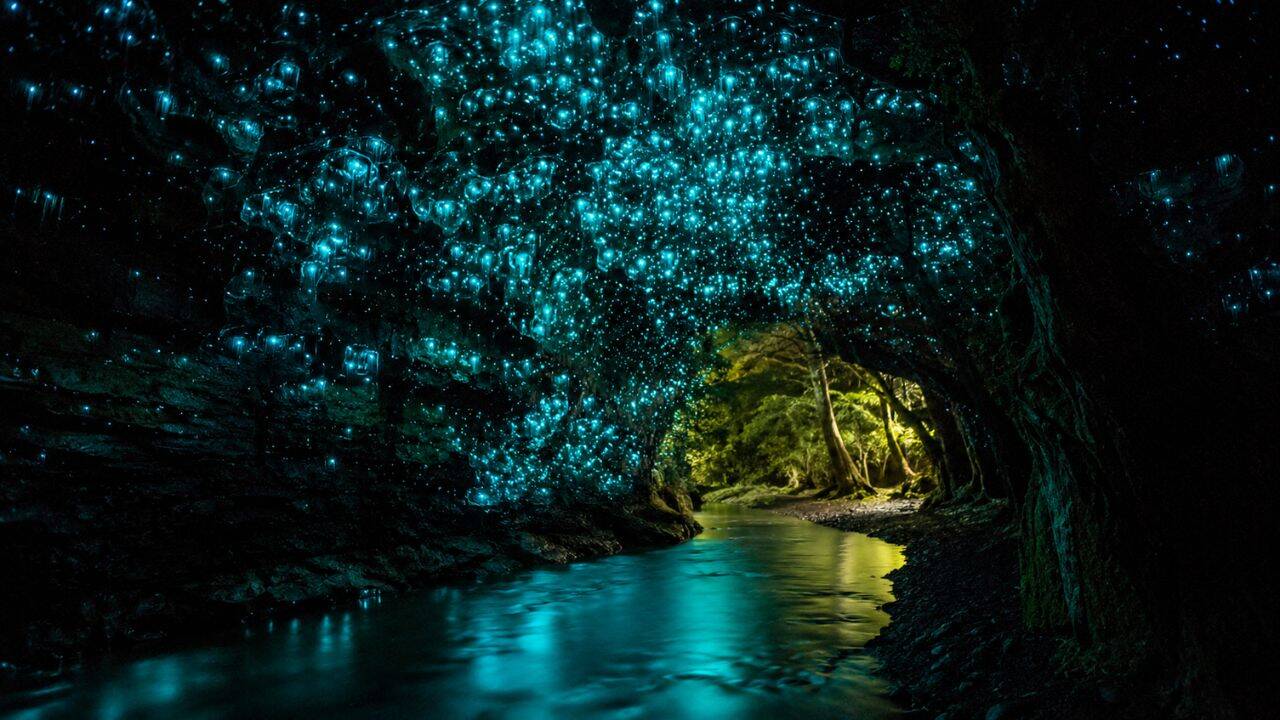
Tiny pinpricks of electric blue-green light begin to pierce the dark. One by one, they emerge along damp earthen banks, under mossy tree roots, and across overhanging rock faces. Within minutes, the entire forest wall looks like a star-filled night sky turned completely upside down. You feel like you're floating in outer space, surrounded by a swirling galaxy of alien stars.
But you aren't looking at stars. You are looking at thousands of hungry, carnivorous maggots.
While most travelers shell out big bucks to see this phenomenon in crowded tourist caves, New Zealand's native forests offer this breathtaking cosmic display completely for free. Here is the real science, the brutal survival tactics, and the exact locations behind why New Zealand's forests turn into glowing galaxies after the sun goes down.
The Tiny Predator Behind the Magic
To understand this display, we have to look past the romanticized tourism brochures. The creature responsible for this stunning light show is Arachnocampa luminosa.
Locals call them glowworms. But they aren't worms at all.
They are the larval stage of a specialized fungus gnat, a tiny insect endemic only to New Zealand and small pockets of Australia. Māori communities have known them for centuries as tītīwai, which translates beautifully to "lights reflected in water."
The gnat's life cycle is a bizarre, unbalanced journey. The adult flies live for only a few days. They don't even have mouthparts. They cannot eat. They exist solely to mate, lay eggs, and die. Because of this, the entire survival of the species rests on the larval stage, which lasts anywhere from six to nine months.
During this long childhood, these tiny larvae need to eat. A lot. And to do that, they have evolved one of the most brilliant, predatory hunting systems on Earth.
The Biological Science of the Glow
The light you see in the dark forest is a product of bioluminescence. But the way Arachnocampa luminosa produces this light is chemically unique.
Many people assume glowworms use the exact same chemical process as fireflies. Recent research shows that isn't true. While fireflies rely on a standard combination of enzymes, a 2018 study from the University of Otago revealed that New Zealand glowworms produce their light using a completely unique type of chemical compound called a luciferin, synthesized from xanthurenic acid and tyrosine.
This chemical reaction takes place inside a specialized organ located at the very end of the larva's abdomen.
This organ is actually a modified version of the insect's Malpighian tubules. In simple terms, they glow from their equivalent of a kidney.
The chemical process is incredibly efficient. Nearly $100%$ of the energy generated is converted directly into light, meaning it produces zero heat. If the reaction generated heat, the fragile, soft-bodied larva would cook itself.
An internal airbag surrounds this light organ. It supplies a constant stream of oxygen to fuel the chemical reaction while acting as a natural, silvery reflector to bounce the blue-green light outward into the dark forest night.
The Lethal Fishing Lines of the Forest Floor
Now, why are they glowing in the first place? They aren't trying to put on a show for hikers. They are fishing.
Each individual glowworm larva constructs a small, hammock-like nest of silk on a damp vertical surface, like a clay bank, a tree trunk, or a cave wall. Once settled, the larva lets down dozens of thin, vertical silk threads.
- The Lines: A single larva can dangle up to 70 individual lines.
- The Glue: Each line is dotted with tiny, sticky beads of acidic mucus, spaced out like pearls on a necklace.
- The Trap: These lines hang anywhere from 2 to 15 centimeters down, swaying gently in the forest breeze.
In the pitch darkness of the forest, small flying insects like midges, mayflies, moths, and mosquitoes mistake the glowing blue-green lights for the open night sky or moonlight filtering through the canopy. They fly toward the glow, only to crash into the sticky, mucus-covered lines.
The moment an insect gets snagged, the vibrations alert the larva. It slowly reels the silk line back up into its mouth, ingesting the line itself to save energy, and eats the prey alive.
Here is a detail most tourists miss. The hungrier a glowworm is, the brighter it glows. If a larva has had a massive meal, its light dims significantly. But if it hasn't eaten in days, its chemical reactor kicks into overdrive, shining with intense brightness to lure in a meal as fast as possible. When you see a brilliant, blinding cluster of lights in a forest glade, you aren't looking at a peaceful celestial community. You are looking at a group of starving, highly competitive predators.
Why Forest Banks Look Better Than Caves
Most travel guides push tourists toward the famous subterranean cave networks of Waitomo or Te Anau. While those caves are spectacular, the forest experience is entirely different and, in many ways, much more magical.
In a cave, you are often packed into a boat with dozens of other tourists, whispered at by a tour guide, and rushed through a designated route.
In the forest, you are completely on your own.
Forest glowworms choose damp, sheltered environments where the canopy is thick enough to block out moonlight and wind. They colonize overhanging clay banks, the undersides of fallen tree trunks, and the edges of slow-moving streams.
Because the forest air moves more than cave air, the hanging fishing lines are shorter to prevent them from tangling. This means the larvae sit closer to the mossy earth. When you stand quietly in front of a glowing forest wall, you can see the lights mirroring off the wet leaves and damp soil around your feet. The boundary between the earth and the night sky completely dissolves.
Where to Find Forest Galaxies in New Zealand
If you want to skip the expensive cave tours and find these outdoor galaxies on your own, you need to know where to look. Glowworms need three things to thrive: high humidity, protection from drying winds, and complete darkness.
Here are some of the best, most accessible free forest walks in the country where you can see them.
The Glow Worm Dell in Hokitika (South Island)
Located right on the edge of the West Coast town of Hokitika, this is one of the easiest ways to see them. A short, level, two-minute walk from the roadside takes you into a damp, sandstone semi-cave covered in thousands of glowing lights. It is completely free and accessible for almost any fitness level.
McLaren Falls Park in Tauranga (North Island)
If you are on the North Island, head to McLaren Falls Park just outside of Tauranga. After dusk, take the short Waterfall Flat track. The damp banks alongside the stream turn into a massive wall of blue-green lights. It feels like walking through a fantasy film set.
Minnehaha Walk in Fox Glacier (South Island)
This loop walk winds through a beautiful rain forest alongside a small stream. By day, it is a lovely walk showcasing giant tree ferns and mosses. By night, the banks of the stream come alive with hundreds of tiny blue lights. The walk takes about twenty minutes and is highly rewarding.
How to Visit Without Ruining the Experience
Because these creatures are incredibly fragile, visiting them requires a strict code of conduct. Glowworms are easily disturbed, and making a few common mistakes can ruin the display for yourself and anyone who walks in after you.
- Turn off your lights: Your eyes need at least ten minutes to fully adjust to the darkness. Avoid using bright white flashlights or phone screens. If you must use a light to navigate the path, use a dim red light, which does not disrupt the glowworms' biological rhythm.
- Keep your voice down: Vibrations and loud noises cause the larvae to instantly douse their lights. They perceive noise and movement as a threat. If you start talking loudly, the "galaxy" will simply vanish.
- Never touch them: The silk lines are incredibly delicate. Touching them destroys the traps, and touching the larva itself can easily kill it.
- No flash photography: You cannot capture glowworms with a standard phone flash. The flash will only blind you, ruin the night vision of everyone around you, and cause the glowworms to turn off their lights for hours. To photograph them, you need a tripod, a camera with manual controls, a wide aperture, and a long exposure of thirty seconds or more.
Your Next Steps for a Night Walk
To plan a successful glowworm night walk, do not just head out blindly after dinner.
First, visit your chosen trail during the daytime. This is a crucial safety step. New Zealand forest paths can have exposed tree roots, steep drop-offs, and muddy patches. Navigating these for the first time in pitch darkness is a recipe for a twisted ankle. Mark out the locations of damp, overhanging banks and stream crossings where the air feels cool and moist.
Once night falls, pack a flashlight equipped with a red-light filter, dress warmly—even summer nights in New Zealand forests get incredibly cold—and head out at least one hour after sunset. Walk slowly, tread softly, and prepare to see the forest floor transform into a living cosmos.