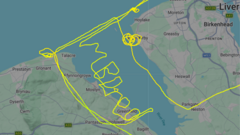
Ever feel like pulling your hair out during a tedious afternoon at work? We've all been there, staring blankly at a screen, counting down the minutes. But when you're a flight instructor flying a light aircraft over the UK, your office cubicle is thousands of feet in the air, and your canvas happens to be the digital radar screens of the entire world.
That's exactly what happened when a young pilot in his 20s took off from Liverpool John Lennon Airport. Tasked with a routine test flight following a part replacement on a Piper Tomahawk, he found himself with two hours to kill. Instead of flying in mindless circles over the Irish Sea, he used his flight path to spell out a massive "I'm bored" over the River Dee and Wirral peninsula.
The internet instantly fell in love with the stunt after it popped up on Flightradar24. While the mainstream media framed it as a funny little story about a slacking employee, they completely missed the real story. Tracing perfectly legible English letters in a light aircraft isn't just a hilarious cry for help—it's a brutal demonstration of aerial precision.
The Absolute Madness of Radar Art
Let's clear up one major misconception right away. People see these stories and think the pilot is leaving a trail of smoke in the sky like a skywriter at a beach resort. He wasn't.
If you stood on the ground in Cheshire or North Wales that Saturday afternoon, you wouldn't see a thing. The sky was perfectly clear. This wasn't smoke; it was digital ink. The message was created entirely through the plane's GPS transponder pining data to flight-tracking websites.
Think about trying to write your name in cursive while driving a car in a massive, empty parking lot. Now, imagine doing that without looking backwards, while dealing with crosswinds, shifting air currents, and maintaining a constant altitude. Oh, and you can't hit an eraser if you mess up the letter "b."
Wayne Barrett, the operations manager at Ravenair—the company that owns the plane—hit the nail on the head when he admitted it was "pretty skilful flying." The pilot had to carefully calculate each turn, bank angle, and straight line to make sure the tracking software interpreted the path as crisp letters rather than a chaotic mess of spaghetti.
Why Pilots Choose to Draw in the Sky
Aviation can be an incredibly structured, repetitive profession. When an aircraft gets a new engine component—like the cylinder replacement on this specific Piper Tomahawk—it has to be run in. That means flying the plane at specific power settings for a prolonged period to make sure everything functions safely before it goes back to training students.
It is a necessary job, but it is also mind-numbing.
This anonymous instructor isn't the first to crack under the weight of airborne monotony. Pilots have a long, proud history of messing with flight trackers. We've seen commercial crews draw massive Christmas trees over Europe and Boeing test pilots trace the giant silhouette of a 787 Dreamliner across the United States.
And yes, military and civilian pilots alike have a notorious habit of drawing giant phallic symbols when they think nobody is paying attention. It's the ultimate insider joke in the aviation community.
What Happens When Your Boss Catches You
In most jobs, getting caught telling the entire internet that you are bored out of your mind would lead to a swift trip to HR. Aviation takes professionalism seriously, but thankfully, the industry still has a bit of a sense of humor.
The pilot didn't break any airspace rules, didn't endanger anyone, and successfully verified that the aircraft was safe for future flights. Ravenair confirmed he wasn't in any formal trouble, though they did give him a couple of days off to let the media storm blow over.
Honestly, it's the best kind of PR the flight school could ask for. It shows their instructors possess incredible spatial awareness and stick-and-rudder skills.
How to Track Your Own Sky Art
If you want to spot these hidden gems yourself, you don't need a military-grade radar dish. You just need to know where to look.
- Download Flightradar24 or FlightAware: These apps pull live ADS-B data from aircraft globally.
- Filter for Light Aircraft: Look for general aviation airports or training fields on quiet weekdays.
- Watch the Test Flights: Whenever a plane is flying repetitive patterns near a maintenance hangar, keep your eyes peeled. You might just catch a frustrated pilot drawing their next masterpiece.
Next time you are stuck in a boring meeting, just be glad your midday slump isn't being broadcasted to millions of aviation geeks worldwide.