Imagine being stranded on a crumbling iron hull, shivering in your night clothes, staring at a rocky shoreline less than a hundred yards away. You can see the trees. You can see the land. Later, you can even see rescue ships sitting comfortably on the horizon. Yet, nobody is coming to save you because the ocean between the ship and safety is a churning, violent washing machine of rocks and freezing surf.
That was the horrific reality for the passengers of the SS Valencia on January 22, 1906.
When people talk about maritime disasters, the Titanic dominates the conversation. But the sinking of the SS Valencia off the coast of Vancouver Island stands as one of the most agonizing, slow-motion tragedies in seafaring history. It didn't happen in the deep ocean. It happened right on the coast, inside the infamous "Graveyard of the Pacific," a treacherous stretch of water between Oregon and Vancouver Island that has claimed thousands of ships. Out of 173 people on board, only 37 survived. Every single woman and child perished.
The real tragedy isn't just that the ship hit a reef. It's that the entire disaster was a chain reaction of human error, terrible ship design, panicked decisions, and a spectacular failure of coastal rescue infrastructure.
The Fatal Guesswork of Dead Reckoning
The SS Valencia wasn't built for the brutal winter conditions of the Pacific Northwest. Built in 1882 for the Red D Line, she spent her early years running comfortable, warm routes between New York and Venezuela. She was an iron-hulled steamer, but her design featured a long, 100-foot bow that severely restricted visibility from the bridge. Even worse, the sound of waves slamming into that extended bow made it incredibly difficult for crew members to hear each other during a storm.
On January 20, 1906, the Valencia left San Francisco bound for Victoria and Seattle. It was supposed to be a routine coastal run. But as she traveled north, the weather turned into a nightmare of thick fog, blinding rain, and violent winds.
In 1906, navigators couldn't rely on GPS or radar. When visibility dropped to zero, they used a system called dead reckoning. Essentially, you calculate your position based on your last known location, your estimated speed, and your compass heading. It works fine in calm waters. It's deadly when strong, invisible ocean currents push your ship off course without you realizing it.
Captain Oscar Marcus Johnson knew he was flying blind. He couldn't find any coastal landmarks to verify his position, so he ordered the crew to take depth soundings to figure out how close they were to land. John Marks, a sailor on board, was taking these depth measurements just fifteen minutes before the disaster.
The crew thought they were safely approaching the entrance to the Strait of Juan de Fuca. They weren't even close. Strong currents had dragged the Valencia much further north than calculated. Instead of steering into a safe shipping channel, they were heading straight toward the jagged, vertical cliffs of Vancouver Island.
Panic at Midnight
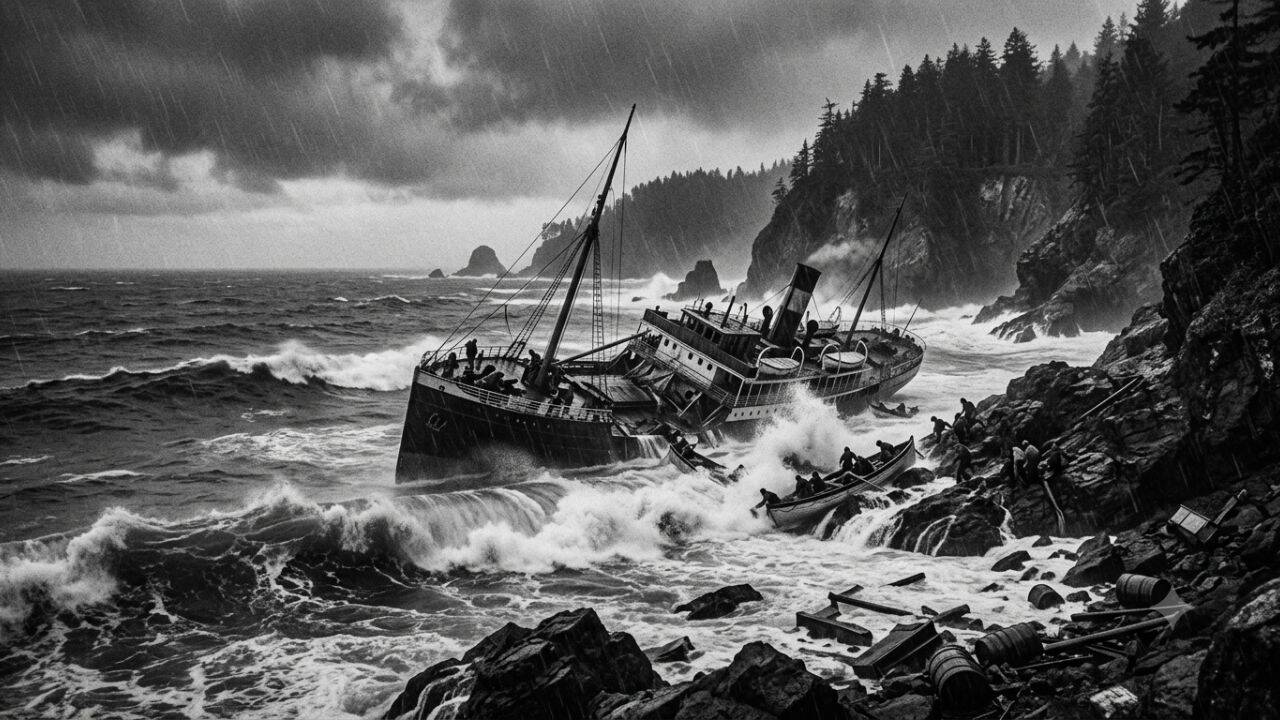
Just before midnight on January 22, the Valencia slammed hard into the reef near Pachena Point.
[SS Valencia Route] ---> Miscalculated Currents ---> Missed Strait ---> Struck Reef
A massive wave instantly lifted the ship and dropped it back down, tearing a huge gash in the iron hull. Water rushed into the engine room. Fireman William Doherty and his crew worked in pitch blackness, desperately trying to maintain steam pressure as the bridge screamed for full speed astern. They managed to back off the reef, but the ship was flooding too fast. Knowing the steamer would sink in deep water, Captain Johnson made a desperate choice: he drove the Valencia straight back into the rocks to ground her.
She became wedged on the reef, barely a hundred yards from the towering cliffs of the island.
What happened next was pure chaos. The captain ordered the passengers to stay calm and wait for daylight. But fear took over. Passengers and panicked crew members rushed the lifeboats against direct orders.
The Valencia carried six lifeboats, but launching them in black darkness while waves crashed over the deck was a death sentence. Three boats flipped while being lowered, dumping their occupants directly into the freezing, churning surf. In one horrific mistake, a passenger accidentally cut the ropes on one side of a lifeboat. Freight clerk Frank Lehm watched in horror as the stern dropped instantly, spilling people into the boiling sea like pebbles from a glass.
Seeing the first few lifeboats smash into pieces or flip upside down, the remaining women and children on deck refused to get into the remaining boats. They huddled together as the ship began to break apart under the relentless hammering of the waves.
Stranded in Sight of Safety
By the morning of January 23, the situation was a psychological nightmare. The ship was split, and the remaining survivors were forced onto the hurricane deck and into the freezing rigging. They could see the shoreline. It looked agonizingly close.
A few small groups of men miraculously made it to land. A group known as the "Bunker Party," led by passenger Frank Bunker, managed to scramble up the sheer, 100-foot cliffs after their boat smashed near the rocks. They found a telegraph line strung through the dense forest, followed it to a lineman’s cabin, and successfully broadcasted news of the shipwreck to the outside world. Another crew member, Boatswain Timothy McCarthy, led a small crew in a boat to try and reach land to secure a lifeline from the ship, but the currents dragged them miles away.
The tragedy worsened because help arrived, but it couldn't do anything.
By January 24, several rescue ships, including the passenger liner Queen and the federal steamer Topeka, arrived on the scene. But the ocean around the wreck was a death trap of hidden reefs and massive breakers. The rescue ships stayed out in deeper water, completely unable to get close enough to pull anyone off the disintegrating hull. Survivors on the wreck watched the rescue ships sit safely a kilometer away, seemingly unwilling or unable to help.
Desperate and freezing, the remaining men on board launched the final two life rafts. Out of ten men on the first raft, only four survived the brutal currents to land on Turret Island. The second raft was eventually picked up by the Topeka, saving nineteen more lives, including assistant engineer Thomas Carrick and a German baker named Charles Fluhme.
Back on the ship, the end came quickly. Around noon on January 24, after 36 hours of enduring the freezing wind and rain, a series of massive waves washed over the remains of the Valencia. The rescuers on the nearby ships watched in absolute horror as the final group of survivors was swept into the sea.
Ghosts and Legacies
The Valencia didn't just fade away into old newspaper archives; it became the ultimate ghost story of the Pacific Northwest.
Because the rugged coastline was so inaccessible, bodies and debris washed up for months. Organized labor groups eventually recovered several unidentified bodies from the beaches and buried them at Mt. Pleasant Cemetery in Seattle, where a monument stands today.
But the strange occurrences kept the disaster alive in local folklore. Local fishermen swore they saw a phantom shape of the Valencia trapped in the mist near Pachena Point, its decks filled with screaming spirits doomed to relive their final hours. Rumors spread of a sea cave where a missing lifeboat sat perfectly preserved, guarded by the skeletons of eight passengers.
The weirdest piece of the puzzle happened in 1933. Twenty-seven years after the sinking, Lifeboat No. 5—the very boat McCarthy had used to escape—was found floating upside down in Barkley Sound. Amazingly, it was in near-perfect condition, with much of its original paint and its nameplate completely intact. It was as if the ocean had decided to vomit up a pristine piece of the tragedy decades later.
What You Should Do Next
The Valencia disaster changed maritime law forever. The public outrage over the 136 preventable deaths forced both the Canadian and American governments to completely overhaul coastal safety. They built the Pachena Point Lighthouse right near the wreck site. They organized better sea rescue systems.
Most famously, they carved a lifesaving trail through the brutal Vancouver wilderness so that future shipwrecked mariners could hike to safety instead of dying at the base of a cliff. Today, that rugged path is known worldwide as the West Coast Trail, a bucket-list destination for hardcore backpackers.
If you want to truly understand the scale of this history, here is your playbook:
- Hike with respect: If you ever tackle the West Coast Trail on Vancouver Island, remember you're literally walking on the "Life Saving Trail" built because of the Valencia victims. Take time to look out at the reefs near Pachena Point.
- Visit the Maritime Museum of British Columbia: Located in Victoria, this museum holds artifacts and deep archival records from the wreck, giving you a tangible connection to the event.
- Check out the Seattle Monument: If you're in Washington, visit the Mt. Pleasant Cemetery to see the SS Valencia Shipwreck Monument erected by organized labor to honor the unidentified crew and passengers who never made it home.
The sea doesn't care about human error or bad weather calculations. The true legacy of the Valencia isn't just the horror of what happened on those rocks, but the hundreds of thousands of lives saved since by the navigation systems and trails built from its wreckage.