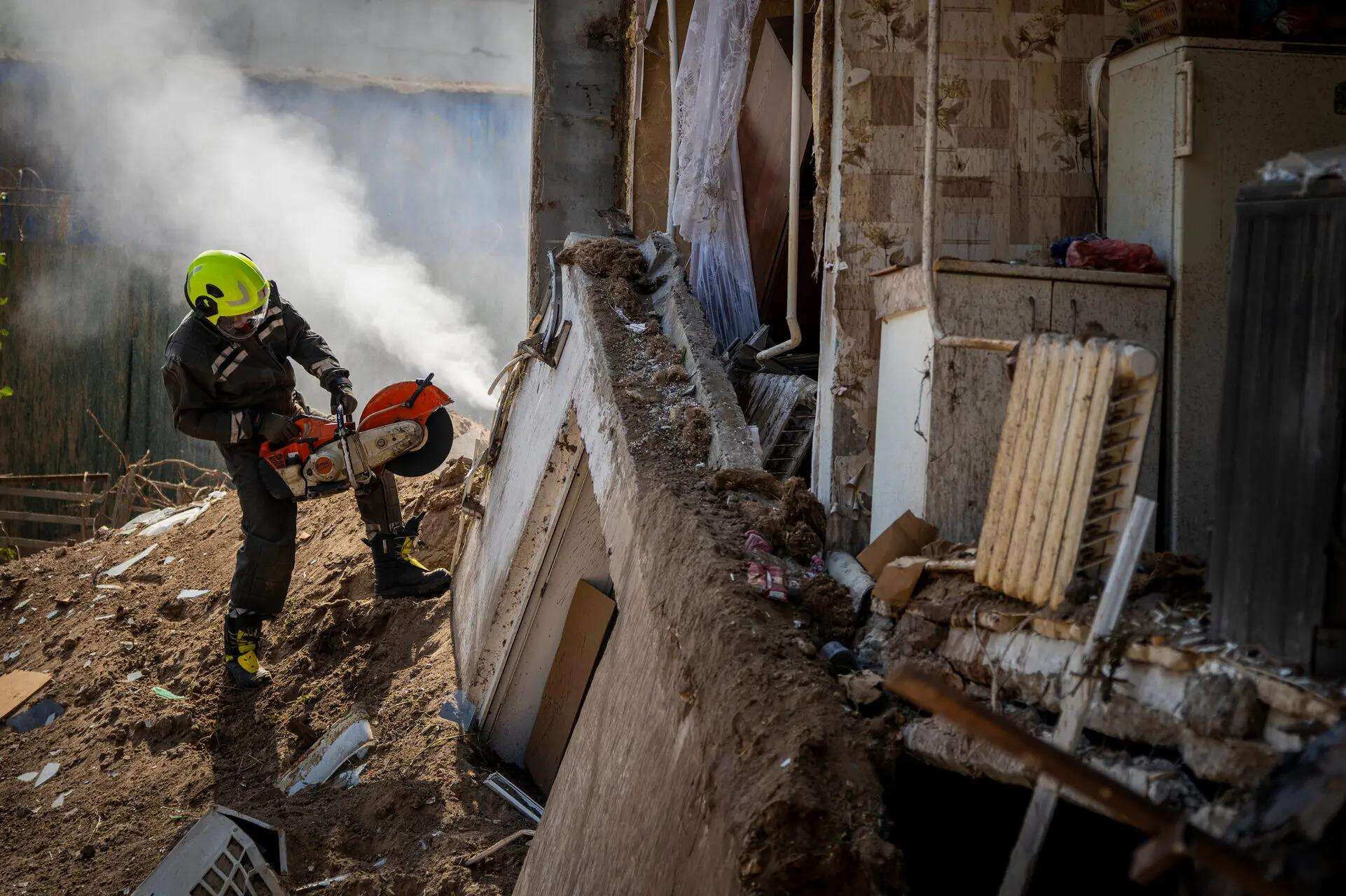
Russia just sent a brutal message written in fire and steel. Hours before Ukrainian President Volodymyr Zelenskyy sat down with US President Donald Trump at the NATO summit in Ankara, Russian missiles rained down on cities across Ukraine. It was not a random act of aggression. It was a calculated, vicious exclamation point designed to pressure both leaders before they even shook hands.
The strikes killed a mother and her daughter in the southern region of Mykolaiv. They set warehouses ablaze in Kyiv. They left wounded civilians scattered across Dnipropetrovsk, Zaporizhzhia, and Kharkiv. Moscow is sending a clear message to the West. They want everyone to know that no matter what gets discussed in Turkey, the bombardment will not stop.
This latest escalation highlights a critical reality that many commentators are missing. Ukraine is not just fighting a war of attrition on the ground. It is running out of time in the skies. The Kremlin has shifted its strategy. They are bypassing drone swarms and using fast, hard-to-intercept ballistic missiles to overwhelm Ukrainian air defenses. If NATO leaders do not make hard choices right now, the consequences will be devastating.
The Strategy Behind Russia's Midnight Ballistic Terror
Moscow knows how to read a calendar. This attack follows a horrific bombardment just days earlier that killed dozens in Kyiv. Targeting the capital right before a high-stakes diplomatic meeting is a classic Kremlin playbook move. They do it to project absolute strength.
For months, Ukraine managed to shoot down a massive percentage of incoming Russian threats. Suicide drones were noisy and slow. Air defense teams picked them off with relative ease. But things changed. Moscow noticed that Ukraine was burning through its stockpiles of expensive interceptor missiles. So, they changed their approach.
Now, Russia relies heavily on ballistic missiles. These weapons travel on high, steep trajectories at extreme speeds. You cannot shoot them down with anti-aircraft guns or shoulder-fired weapons. You need sophisticated, high-end systems like the US-made Patriot network. Russia knows that these interceptors are rare, expensive, and difficult to replace. By raining ballistics down on Kyiv and other major hubs, the Russian military forces Ukraine to make impossible choices. Do they protect a power plant, a military base, or a residential block?
The technical reality is grim. Air defense networks are running low on ammunition. Zelenskyy has spent months warning allies about this exact bottleneck. When a barrage hits a city before the air sirens can even sound, it means the defense grid is stretched to its absolute limit. It means the safety net is tearing apart.
What is Really Happening on the Ground Across Ukraine
The human cost of this strategic chess game is felt by ordinary families. The headlines talk about geopolitical tension, but the reality is broken concrete and shattered lives.
In Mykolaiv, guided aerial bombs struck residential areas. These bombs are massive, packed with explosives, and fitted with basic wings to glide from Russian aircraft miles away. They are cheap for Russia to produce but utterly devastating to civilian structures. The attack killed two people instantly. A mother and her daughter died when their home collapsed. Two others were pulled from the wreckage with severe injuries.
In Kyiv, explosions rocked the Podilsky district and other areas before dawn. Firefighters rushed to put out massive blazes at several warehouses and non-residential buildings. Two people were wounded by falling debris. The psychological impact of these early-morning strikes is massive. Residents are forced into underground shelters night after night, wondering if the next blast will hit their building.
Further east, the pressure is relentless. In the Dnipropetrovsk region, Russian forces utilized a combination of drones and heavy artillery to strike urban centers, wounding four people. In Zaporizhzhia, another two civilians were hospitalized after a targeted strike ruined local infrastructure. Kharkiv faced similar terror, with Mayor Ihor Terekhov confirming that two more people were injured in overnight strikes.
This is not a localized front-line battle. It is a nationwide campaign of intimidation. Russia is hitting every corner of the country simultaneously to keep emergency services fractured and panic high.
The Ankara Summit and the Trump Factor
The timing of this onslaught brings the diplomatic stakes in Turkey into sharp focus. The NATO summit in Ankara marks a critical juncture for the future of European security. All eyes are on the meeting between Zelenskyy and Donald Trump.
Trump has frequently claimed that he could end the conflict quickly. He recently noted that a resolution is closer than people realize after holding separate phone calls with both Zelenskyy and Russian President Vladimir Putin. Moscow is trying to influence those exact conversations. By ramping up the violence, Putin wants to signal that any peace deal must happen on Russia's terms. He wants to show Trump that Ukraine is losing ground and that continued Western support is a waste of resources.
Zelenskyy enters this meeting with a vastly different agenda. He is not looking for vague promises or long-term treaties that take years to materialize. He needs immediate tactical support. He needs physical interceptor missiles shipped to Europe immediately.
The political friction within the alliance is palpable. Newly appointed NATO Secretary General Mark Rutte has spent the opening days of the summit pushing member states to increase their defense spending. Rutte has repeatedly praised past American pressure that forced European nations to take their own security seriously. But speeches do not shoot down ballistic missiles. Ukraine needs the United States and European partners to open their stockpiles right now.
The Myth of the Air Defense Shield
A dangerous misconception persists in many Western capitals that Ukraine possesses an impenetrable high-tech shield. People see videos of Patriot systems knocking down missiles and assume the problem is solved. That is a dangerous mistake.
An air defense network is only as good as its supply chain. A single Patriot battery costs over a billion dollars, and each interceptor missile costs millions. More importantly, they take a long time to manufacture. Russia is exploiting this manufacturing bottleneck. They are launching cheap, mass-produced drones alongside their expensive ballistic missiles. The goal is to force Ukraine to use up its best defense missiles on cheap targets.
Once the high-end interceptors are gone, the sky lies wide open. That is exactly what we are starting to see. When a missile hits a building in central Kyiv without the sirens giving residents time to flee, it means the early-warning and interception layers are failing to communicate or lacking the ammunition to act.
Western allies have plenty of missiles sitting in warehouses across the globe. They keep them for their own national defense strategies. But those missiles are needed in Ukraine today. If the skies over Kyiv fall completely, the ground war changes dramatically. Russian bombers will be able to fly directly over Ukrainian cities without fear, dropping thousands of unguided bombs with absolute impunity.
The Shifting Logistics of the Conflict
While Russia maintains its aerial bombardment, Ukraine is not sitting idly by. Kyiv has developed an aggressive long-range drone program to strike back inside Russian territory. They are using domestic technology to hit Russian oil refineries, military airfields, and logistical hubs deep in Siberia.
Recently, a Ukrainian drone strike targeted an infrastructure facility in Russia's Saratov region, resulting in one casualty according to local Governor Roman Busargin. These retaliatory strikes are designed to disrupt the flow of fuel and ammunition to the front lines. They also bring the reality of the war home to the Russian public.
However, there is a massive asymmetry in this exchange. Ukraine is using lightweight, locally built drones to cause economic damage inside Russia. Russia is using industrial-grade, multi-ton ballistic missiles to destroy entire apartment blocks and energy grids in Ukraine. It is an uneven fight. No matter how many Russian oil depots Ukraine manages to burn, it cannot offset the immediate destruction of its own domestic power grid and civilian safety.
What Needs to Happen Right Now
The diplomatic dance in Ankara cannot afford to drag on. The leaders gathered in Turkey need to stop treating this conflict like a distant geopolitical puzzle and start treating it like the immediate crisis it is.
First, Western nations must immediately authorize the transfer of excess air defense stockpiles to Ukraine. Keeping interceptors hidden away in American or European warehouses for a hypothetical future conflict makes little sense when an actual war is destroying the security architecture of the continent today.
Second, the alliance must streamline the procurement and production of anti-ballistic systems. The current manufacturing pace is sluggish and completely unsuited for a high-intensity industrial conflict.
Finally, Trump and Zelenskyy must find common ground on what a realistic, secure peace looks like. If Russia is allowed to use brute force to dictate terms, it sets a terrible precedent for global stability. It tells every aggressive power that if you bomb civilians long enough, the West will eventually get tired and give you what you want.
The next few days will determine the trajectory of the war. If NATO leaders leave Turkey without delivering concrete, immediate military aid packages, the smoke rising over Kyiv and Mykolaiv will only be the beginning of a much darker chapter. Textbooks and policy papers will not save lives next week. Ammunition will. They need to send it now.