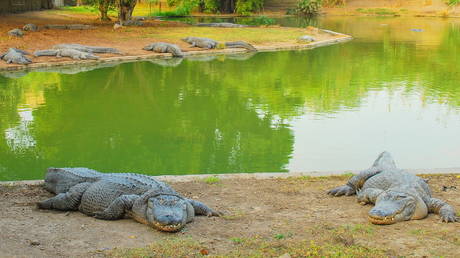
When news first broke that Israel was considering surrounding its detention facilities with reptile-filled moats, most people assumed it was dark satire or a bad internet meme. It sounded like a medieval torture tactic or a cartoon villain's lair, not modern state policy. Yet, what started as an outlandish proposal by far-right National Security Minister Itamar Ben-Gvir is rapidly morphing into actual bureaucratic reality. Reports coming out of Hebrew media confirm that the Israeli government has cleared a massive legal hurdle to make using crocodiles to guard Palestinian inmates a genuine possibility.
This isn't just about security logistics. It highlights a massive shift in how the state handles incarceration, legal norms, and animal welfare laws. By tearing down environmental protections to clear a path for Ben-Gvir’s pet project, the government has shown exactly how far it will go to project absolute deterrence.
How Itamar Ben-Gvir Got His Way and Rewrote the Law
To understand how a modern state ends up building crocodile moats, you have to look at the bureaucratic maneuvering behind the scenes. Under Israeli law, Nile crocodiles were strictly classified as protected wild animals. You couldn't just buy a pack of them and drop them into a trench outside a high-security prison. They were legally restricted to licensed zoos, sanctuaries, and research centers.
Environmental Protection Minister Idit Silman stepped in to change all of that. This week, Silman signed a decree that reclassified Nile crocodiles as a specially managed wild animal. That legal trick gave the state the authority to transfer and maintain these reptiles under conditions tailored for security forces, completely cutting the legs out from under previous environmental restrictions.
Snubbing the Experts
Silman didn't do this with the backing of her department. She did it by actively defying her own ministry’s top legal advisor, Neta Drori, who warned that the decree lacked any real professional or legal basis. The Israel Nature and Parks Authority also fought the move tooth and nail. Agency officials pleaded with ministers, arguing that laws exist to protect wild animals from humans, not to turn animals into weapons to protect humans from each other.
Those objections fell on deaf ears. Ben-Gvir and Silman met with the head of the Nature and Parks Authority, Raya Soraki, and basically told the agency that political and security directives trumped environmental conservation. The Israel Prison Service even justified its capability to manage massive man-eating reptiles by claiming their staff already had extensive experience handling aggressive attack dogs. Legal experts scoffed at the comparison, but the political momentum was unstoppable.
The Florida Blueprint and the Creation of Alligator Alcatraz
Where did this bizarre concept come from? Ben-Gvir didn't pull the idea out of thin air. He found inspiration across the Atlantic, specifically in the United States.
The White House established a high-security detention facility built deep within an alligator-heavy zone of the Florida Everglades. Designed to hold migrants and deter unauthorized border crossings, the facility earned the nickname Alligator Alcatraz. It sparked a wave of lawsuits from indigenous populations, human rights watchdogs, and conservationists, but it caught the attention of right-wing politicians globally.
Translating American Tactics to the Middle East
Ben-Gvir saw the Florida project as proof of concept. If Washington could use geographic isolation and apex predators as a psychological and physical barrier, Israel could do the exact same thing.
He pitched the idea during a high-level strategy meeting with Kobi Yaakobi, the chief commissioner of the Israel Prison Service. Far from dismissing it as an eco-nightmare, the prison service treated it as a highly functional tactical upgrade. Senior prison administrators and security teams quickly organized field trips to the Hamat Gader crocodile farm in northern Israel. They wanted to study the logistics of feeding, fencing, and maintaining hundreds of reptiles.
The True Cost of Building a Reptilian Fortress
If you look past the shock value, the actual economics and logistics of this project are staggering. Building a moat capable of containing Nile crocodiles while keeping them active enough to act as a deterrent requires an incredible amount of infrastructure.
- The Price of Predators: A young Nile crocodile costs roughly $8,000. A fully grown adult can set the state back up to $20,000. To ring a massive compound like Ketziot Prison in the Negev desert, you need dozens, if not hundreds, of these animals.
- Thermal and Climatic Controls: Crocodiles are cold-blooded ectotherms. They rely entirely on their environment to regulate body temperature. While the desert heat works in the summer, winter nights in the Negev drop to freezing levels. Keeping these animals alive and aggressive requires heavily managed, heated water systems, which cost millions to install and run.
- Feeding and Containment: Crocodiles don't just sit there for free. They require massive amounts of meat. Furthermore, if the fences suffer even minor degradation, the reptiles will escape into nearby ecosystems or look at the human guards as an easy lunch.
The Israel Prison Service claims that crocodile moats will cut down long-term manpower costs by replacing traditional perimeter guards and high-tech sensor grids. But anyone who has ever managed infrastructure knows that maintaining biological weapons is infinitely more volatile than maintaining a steel fence and a few security cameras.
Inside the Hamat Gader Connection
The geography of this plan is highly intentional. The primary site being eyed for a potential new reptile facility sits near Hamat Gader, located right along the southern edge of the Sea of Galilee, near the borders of Jordan and the occupied Syrian Golan Heights.
Hamat Gader is already famous for housing a major commercial crocodile farm and zoo. By embedding a penal facility right next to an existing population of reptiles, the state can streamline supply lines, share veterinary expertise, and cut transport costs.
The Grim History of Crocodile Farming in the Region
This isn't the region's first run-in with crocodile mismanagement. Not long ago, the Israeli defense ministry had to order a massive cull of over 200 Nile crocodiles at an abandoned commercial skin farm in the West Bank settlement of Petzael.
After the farm went bankrupt and regulations changed, the owner essentially left the reptiles behind. Starving, the crocodiles turned to cannibalism and began escaping through broken fences into local waterways and nature reserves, terrorizing nearby communities. The military eventually had to step in and execute the animals because they posed an existential threat to public safety.
Using crocodiles to guard Palestinian inmates ignores this recent history. If a prison facility loses power, experiences a structural failure, or suffers damage during an escalation, these apex predators won't just stay in their moats. They'll become an uncontrollable hazard for everyone in the region.
Human Rights Concerns and the Bigger Picture
The timing of this crocodile prison project isn't random. It coincides with a massive push by Ben-Gvir and his allies to radically alter the legal and physical reality for the roughly 9,500 Palestinian detainees currently held within the Israeli penal system.
At the exact same time this reptile decree was being signed, the Knesset was moving forward with a highly controversial bill pushed by Ben-Gvir that would allow the state to execute Palestinian prisoners convicted of security offenses. International human rights groups, alongside local Israeli organizations, have repeatedly sounded the alarm over deteriorating conditions within these camps, citing severe overcrowding, systemic starvation, and widespread medical neglect.
Adding a moat of man-eating reptiles to this volatile mix isn't designed for simple prison security. Escapes from maximum-security facilities like Ketziot are already nearly impossible due to layers of concrete, drones, and deep underground barriers. The crocodiles are a psychological weapon. They serve as a visceral statement to the prisoners and the public that the state is willing to strip away the thin veneer of modern international prison standards in favor of raw, ancient intimidation.
What Happens Next
The legal reclassification signed by Minister Silman means the roadblocks are officially gone. The Israel Nature and Parks Authority is planning an emergency meeting to contest the decision, but their chances of reversing a ministerial directive backed by the national security apparatus are incredibly slim.
If you want to track where this goes, keep your eyes on the budget allocations for Ketziot Prison and the Hamat Gader border zones over the next few months. Look for concrete contracts involving deep-trench excavation, commercial meat supply agreements, and infrastructure spending hidden under the guise of peripheral security upgrades. The transition from a shocking headline to an operational, reptile-encircled detention center has already passed its most difficult political checkpoint.