Rockets are fast, but they are incredibly dumb when it comes to fuel efficiency.
Every orbital rocket you have ever seen spent most of its weight carrying liquid oxygen just to burn its fuel. Jets, on the other hand, are highly efficient because they suck in oxygen from the surrounding air. But jets cannot fly in space, and they struggle to reach hypersonic speeds.
The US Air Force seeks a new engine for rockets that fly like jets to bridge this massive technological gap. They want a propulsion system that offers the raw power of a rocket with the operational flexibility and efficiency of a jet engine. This is not just a minor upgrade. It is a fundamental shift in how we think about high-speed flight, orbital access, and rapid global logistics.
Let us look at why the military is pushing so hard for this technology, the engineering hurdles holding it back, and who is leading the charge to build it.
The Physics Problem of Traditional Flight
To understand why the military wants a hybrid system, you have to look at the limitations of our current propulsion systems.
Traditional jet engines use a compressor to squeeze incoming air, mix it with fuel, and ignite it. This works beautifully up to about Mach 3. Beyond that speed, the air entering the engine becomes so hot and compressed from its own velocity that the internal turbomachinery starts to melt.
Rockets bypass this limit entirely. They do not rely on incoming air. Instead, they carry their own oxidizer. This allows them to operate in the vacuum of space and reach extreme speeds. But the weight penalty is brutal. About 80% of a rocket's launch mass is just propellant and oxidizer.
This brings us to the core issue. If you want to fly a rocket from point to point on Earth, you have to carry thousands of tons of oxygen through the thickest parts of the atmosphere. It is inefficient, expensive, and requires massive launch pads.
The Air Force wants to eliminate those launch pads. They want vehicles that can take off from a standard runway, accelerate to hypersonic speeds using atmospheric oxygen, and then transition to rocket power to reach the edge of space.
Why the US Air Force Seeks a New Engine for Rockets That Fly Like Jets Right Now
The driving force behind this push is strategic speed. The Pentagon is heavily focused on two concepts: rapid global mobility and hypersonic defense.
Under the Rocket Cargo program, the military wants the ability to transport 100 tons of cargo to any point on Earth within an hour. Using traditional rocket boosters like SpaceX's Starship is one way to do it. But launching a giant vertical rocket requires highly specialized infrastructure. You cannot easily do that from a forward operating base in the Pacific.
A vehicle that uses a hybrid air-breathing rocket engine changes the equation entirely.
- Runway Independence: Vehicles can take off and land using existing military runways.
- Reusability: Standard jet-like operations mean faster turnaround times and lower costs.
- Unpredictable Flight Paths: Unlike ballistic missiles, which follow a predictable arc, a hybrid vehicle can maneuver within the atmosphere to avoid interception.
The Air Force Research Laboratory (AFRL) is actively scouting technologies that can make this a reality. They are looking for propulsion systems that can seamlessly transition between air-breathing mode and pure rocket mode without blowing up.
How Rotating Detonation and Combined Cycle Systems Actually Work
Engineers are pursuing two primary pathways to build a rocket that flies like a jet. Both present massive engineering challenges.
Turbine-Based Combined Cycle Engines
A Turbine-Based Combined Cycle (TBCC) engine combines a standard turbine engine with a ramjet or scramjet.
At low speeds, the turbine does the work. As the vehicle accelerates past Mach 3, the turbine is bypassed, and the air is routed into a ramjet, which uses the vehicle's forward speed to compress the air. Once the vehicle reaches the upper atmosphere where the air is too thin, the system transitions to a closed-loop rocket engine.
The hardest part of this process is the transition phase. Going from turbine to ramjet mode is incredibly difficult to manage. The airflow inside the engine must be carefully controlled using variable geometry inlets. If the shockwave inside the engine gets pushed out of the inlet, the engine suffers an engine unstart. This causes an immediate, violent loss of thrust.
Rotating Detonation Rocket Engines
A more radical approach involves Rotating Detonation Engines (RDEs).
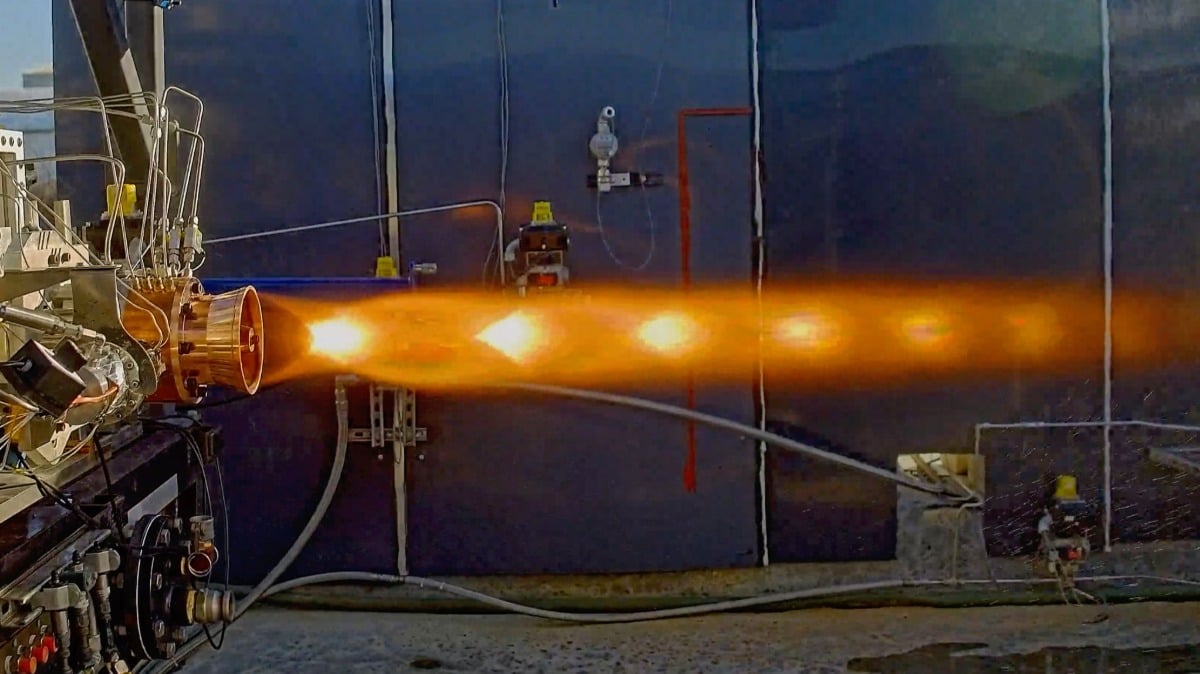
Traditional engines use deflagration, which is a relatively slow burn of fuel and oxidizer. RDEs use detonation. They rely on supersonic shockwaves that travel around a circular channel (annulus) to compress and combust the fuel-oxidizer mixture.
   Incoming Air/Fuel
         │
         ▼
   ┌───────────┐
   │  Annulus  │ <── Supersonic Detonation Wave travels circularly
   └─────┬─────┘
         │
         ▼
   High-Pressure Exhaust
Because the combustion happens so fast, it creates a pressure gain. This means you get significantly more thrust out of the same amount of fuel.
An air-breathing RDE would suck in atmospheric air to sustain this detonation wave at lower altitudes, then switch to liquid oxygen as the air thinned out. The mechanical simplicity of an RDE is highly attractive. It has no moving parts, which makes it lighter and theoretically more reliable than a complex turbine system.
The Players Trying to Build the Impossible Engine
Several aerospace firms and research labs are working on these technologies, each taking a slightly different path.
Hermeus and the Chimera Engine
Hermes has been making waves with its Chimera engine, which is a turbine-based combined cycle system.
They took a commercial GE J85 turbojet engine and integrated it with a proprietary ramjet. The goal is to power their Quarterhorse flight test vehicle to hypersonic speeds. The company has already demonstrated the transition from turbojet to ramjet mode in ground tests. It is a significant step forward, showing that off-the-shelf military turbines can be adapted for hypersonic platforms.
Reaction Engines and SABRE Legacy
For years, the British company Reaction Engines worked on SABRE (Synergetic Air-Breathing Rocket Engine).
The magic of SABRE was its precooler. This heat exchanger could cool incoming air from 1,000°C to -150°C in a fraction of a second, preventing the engine's internals from melting at Mach 5. While Reaction Engines faced severe financial restructuring recently, the core technology and the patents around ultra-lightweight heat exchangers remain highly relevant to the Air Force's current search.
GE Aerospace and Pratt & Whitney
The traditional defense giants are not sitting out. Both GE and Pratt & Whitney are working on advanced rotating detonation systems.
GE Aerospace successfully demonstrated a rotating detonation combustor operating under subsonic and supersonic conditions. They are leveraging their deep experience in materials science, particularly ceramic matrix composites, to build engine components that can survive the extreme thermal environments created by continuous detonation.
The Real Engineering Obstacles We Have to Face
Despite the optimistic press releases, we are still years away from seeing these engines in operational service. The technical challenges are immense.
Extreme Thermal Management
At Mach 5, the skin of an aircraft can reach temperatures over 1,000°C. The air entering the engine is even hotter.
Standard aerospace alloys will melt under these conditions. Engineers must use active cooling systems, where the cryogenic fuel (like liquid hydrogen or methane) is circulated through the engine walls to absorb heat before being injected into the combustion chamber. This requires complex, high-pressure plumbing that adds weight and points of failure.
Fuel Chemistry and Ignition Limits
At hypersonic speeds, air passes through a scramjet engine in milliseconds.
Mixing fuel with that air and igniting it is like trying to light a match in a hurricane. If the ignition timing is off by a microsecond, the engine flameout occurs. Researchers are experimenting with additives and specialized plasma ignition systems to ensure stable combustion at these extreme velocities.
What Happens Next
The US Air Force is not expecting a production-ready engine overnight. The immediate goal is to fund flight-ready demonstrators that can prove these hybrid systems can scale.
If you are tracking this sector, here are the concrete developments to watch:
- Look for upcoming AFRL contract awards: The Air Force is expected to narrow down its list of propulsion concepts and fund physical prototype testing.
- Monitor Hermeus flight tests: Keep an eye on their Quarterhorse test flights. If they achieve stable transition from turbine to ramjet in flight, it will prove the viability of low-cost TBCC engines.
- Track RDE ground tests: Watch for longer-duration test runs of rotating detonation engines. Currently, most tests last only a few seconds. To be useful, these engines need to run reliably for minutes or hours at a time.