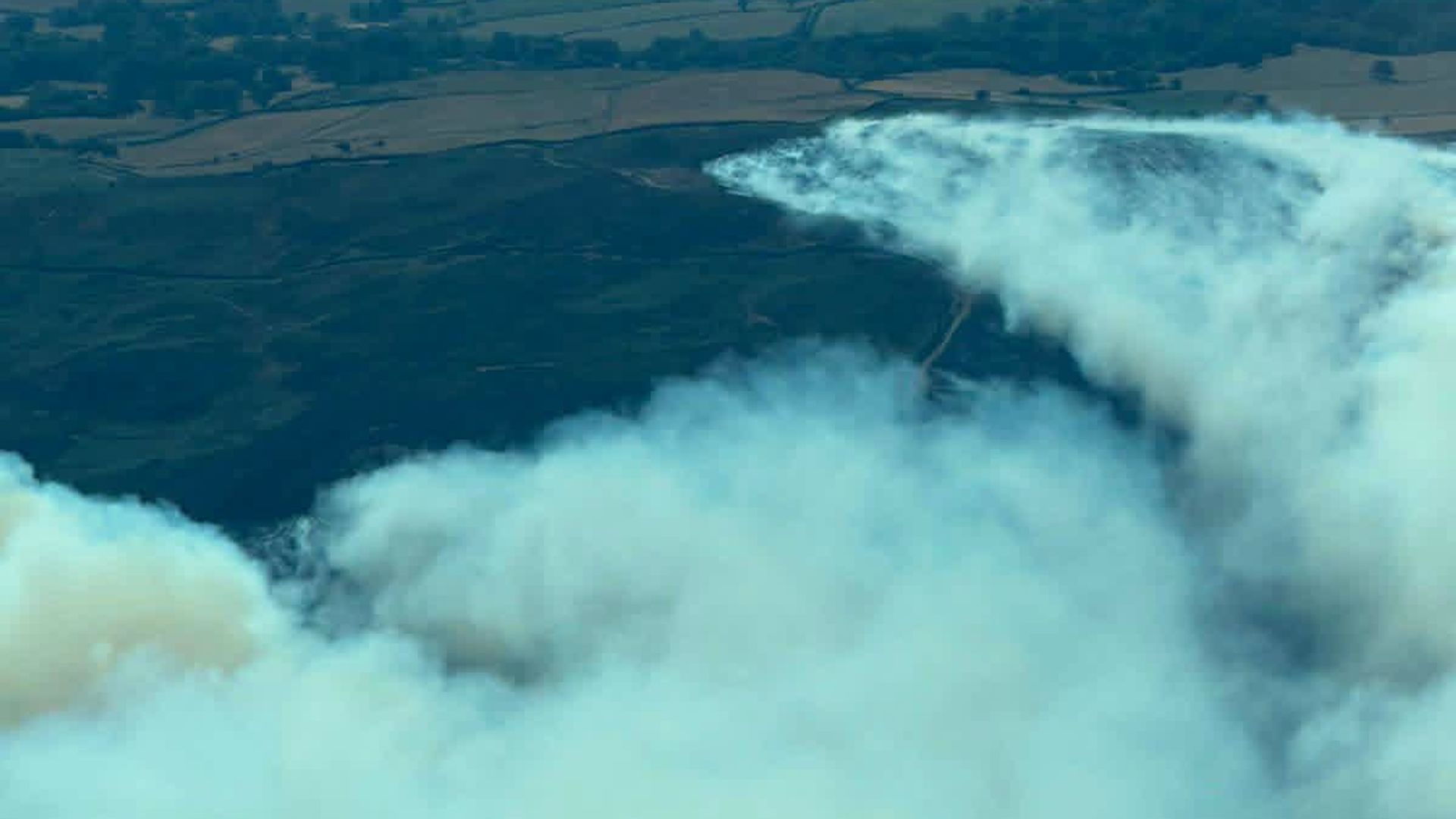
You probably think of wildfires as a foreign disaster. You see images of blazing hillsides in California, Greece, or Spain and thank your luck that you live on a damp, green island. That way of thinking is dangerous. Right now, a major incident is unfolding on Conwy Mountain near the Sychnant Pass in North Wales. Crews are desperately trying to save local communities from a fast-moving wall of flame.
This isn't an isolated stroke of bad luck. It is the frontline of a massive, climate-driven shift hitting the British Isles.
Natural England and the Met Office issued a stark warning. By Thursday, July 16, 2026, huge swathes of England will face an "exceptional" risk of wildfires. This is the absolute highest level on the official scale. Fire services are already stretched thin. Over the weekend, teams tackled blazes at Devil's Dyke in the South Downs National Park, moorland fires in Derbyshire, and a brush fire that shut down rail lines near Stratford station in London.
The heatwave gripping the country is turning our green spaces into tinderboxes. If you think our emergency services, our infrastructure, or our homes are ready for this, you are mistaken. We are completely unprepared for the reality of British wildfires.
The North Wales Emergency is Just the Beginning
North Wales Fire and Rescue Service didn't declare a major incident on a whim. The fire near Sychnant Pass is large, complex, and highly unpredictable. Jami Jennings from the service made it clear that firefighters are dealing with incredibly challenging conditions to protect properties, infrastructure, and the environment. People have been told to stay far away to let the crews do their jobs.
When a fire service uses the term major incident, it means local resources are pushed to their absolute limits. It means the situation requires extraordinary coordination.
Look at what else happened over the last 48 hours. Derbyshire Fire and Rescue dealt with two separate moorland fires. Firefighters in East Sussex scrambled to a large fire in the open on the South Downs near Eastbourne. In London, a shrubbery fire at a major transit hub halted trains. These are not connected by geography, but they are absolutely connected by weather.
The ground is parched. The vegetation is dead or dying. All it takes is a single spark to start a disaster.
Demystifying the Fire Severity Index
The Met Office uses a tool called the Fire Severity Index to track how bad a blaze could get if a fire breaks out. It scores risk from level one up to level five. Level one is low. Level five is exceptional.
Right now, most of England is sitting at very high. By Thursday, a massive portion of the country will cross the threshold into level five.
This index does not tell us where a fire will start. It tells us how violently a fire will behave once it is lit. The system combines several data points:
- Wind speed
- Current temperature
- Time of year
- Recent rainfall
- Relative humidity
Humidity matters far more than people realize. British summers can be humid, but during a prolonged heatwave, the air dries out completely. When relative humidity drops, dead grass, twigs, and leaf litter lose their moisture within hours. They become highly flammable. When you combine that dry fuel with high temperatures and a stiff wind, you get a fire that moves faster than a human can run.
Why Our Infrastructure Isn't Ready for a Hotter UK
We built our towns, railways, and power grids for a climate that no longer exists. A recent study tracked fire weather trends in southeast England since 1960. The data is terrifying. The number of high and very high fire risk days in the summer has dramatically increased. The return period for extreme fire weather days has halved. What used to be a one-in-four-year summer event in the 1960s is now a one-in-two-year event.
We saw the proof of this back in July 2022. Temperatures breached 40°C for the first time in British history. On that day, the London Fire Brigade had its busiest afternoon since the Blitz of World War II. A grass fire tore through the village of Wennington in east London, destroying 20 homes.
That was our warning shot. We didn't listen.
Many British homes are built right up against heathlands, forests, and fields. Urban planners call this the wildland-urban interface. In the UK, we just call it the countryside. Our houses are designed to trap heat to keep us warm in the winter. They are made with wooden fences, PVC guttering, and manicured gardens that quickly dry out. When a wildland fire hits the edge of a British suburb, it jumps from garden to garden with ease.
Our emergency services are also fighting with one hand tied behind their backs. Wildfire firefighting requires specialized training, high-mobility vehicles, and massive amounts of water. Most UK fire brigades are configured to fight house fires and car accidents. They are not funded or equipped to wage multi-day campaigns across miles of burning terrain.
The Human Element is the Real Danger
The heat creates the perfect conditions for a fire, but humans almost always provide the spark. Dave Swallow from the National Fire Chiefs Council pointed out that the vast majority of these incidents start because of human negligence.
Think about your own habits during a hot week. Do you see people using disposable barbecues in parks? Have you seen smokers toss cigarette butts out of car windows? These actions are no longer just annoying littering. They are acts of arson by proxy.
A glass bottle left on dry grass can act as a magnifying glass. It focuses the harsh midday sun onto a tiny patch of dried vegetation. Within minutes, you have a smoldering ember. If a breeze catches that ember, the entire field goes up.
We need a massive cultural shift in how we treat the outdoors during a heatwave. If you are packing a disposable barbecue for a trip to a national park this week, leave it at home. It is not worth risking a whole hillside.
Looking Across the Channel for a Grim Preview
If you want to know what our future looks like, look at southern Europe. The past week has been catastrophic across Spain and France. A massive blaze in southeastern Spain has claimed 12 lives, with more than 20 people still missing. In France, a firefighter lost their life trying to contain a raging forest fire.
We used to think those disasters were contained to the Mediterranean. They are moving north. The same atmospheric conditions cooking Europe are pushing hot, dry air masses straight over the English Channel.
The UK Health Security Agency extended its heat-health alerts through Wednesday evening. Amber alerts cover the West Midlands and the South West. Yellow alerts cover London, the South East, the East of England, the East Midlands, and the North West. Health services are braced for a surge in heatstroke cases and water-related accidents as people flock to rivers and beaches to cool down.
The pressure on our public services this week will be immense. Firefighters will be battling blazes in thick, heavy protective gear while temperatures soar past 30°C. The risk of heat exhaustion for emergency workers is an immediate threat to life.
How to Protect Your Own Property Right Now
You don't have to sit by and wait for a disaster to happen. If you live near an area of open land, heath, or tall grass, you need to take immediate steps to protect your home.
Start by creating a defensible space around your property. Clear out any dead leaves, twigs, and pine needles from your gutters and roofs. If a fire drops embers on your roof, these dry patches will catch fire instantly.
Move flammable items away from your house walls. This includes wooden garden furniture, stacks of firewood, and wheelie bins. If you have a lawn, keep it cut short and water it if local regulations allow. Long, dried-out grass acts as a fuse that guides fire directly to your door.
Check your boundary fences. Wooden fence panels are highly combustible. If your fence connects to a patch of wild brush, a fire will use that fence like a highway to reach your home. Trim back any overhanging tree branches or thick bushes that touch your house or garage.
Talk to your neighbors. Fire doesn't care about property lines. If your neighbor's garden is full of dry rubbish and overgrown brambles, your house is at risk too. Work together to clear shared boundaries.
Make an evacuation plan today. Don't wait until smoke is filling your street to decide what to pack. Gather your essential documents, medications, and items for your pets. Know exactly which routes you can take to leave your neighborhood if the main road is blocked by emergency vehicles. If emergency services tell you to evacuate, leave immediately. Do not stay behind to try and save your property with a garden hose. You will only get in the way and endanger your own life.
Keep an eye on the Met Office daily updates. Stay informed about the Fire Severity Index in your specific area. Avoid lighting any bonfires, using fireworks, or operating machinery that could strike a spark against rocks in dry fields. The next few days will test our emergency infrastructure to its breaking point. Staying vigilant is the simplest way to ensure your family stays safe.


_03.jpg)