You can't just paint a national monument like it's a backyard swimming pool and expect the laws of nature to sit this one out.
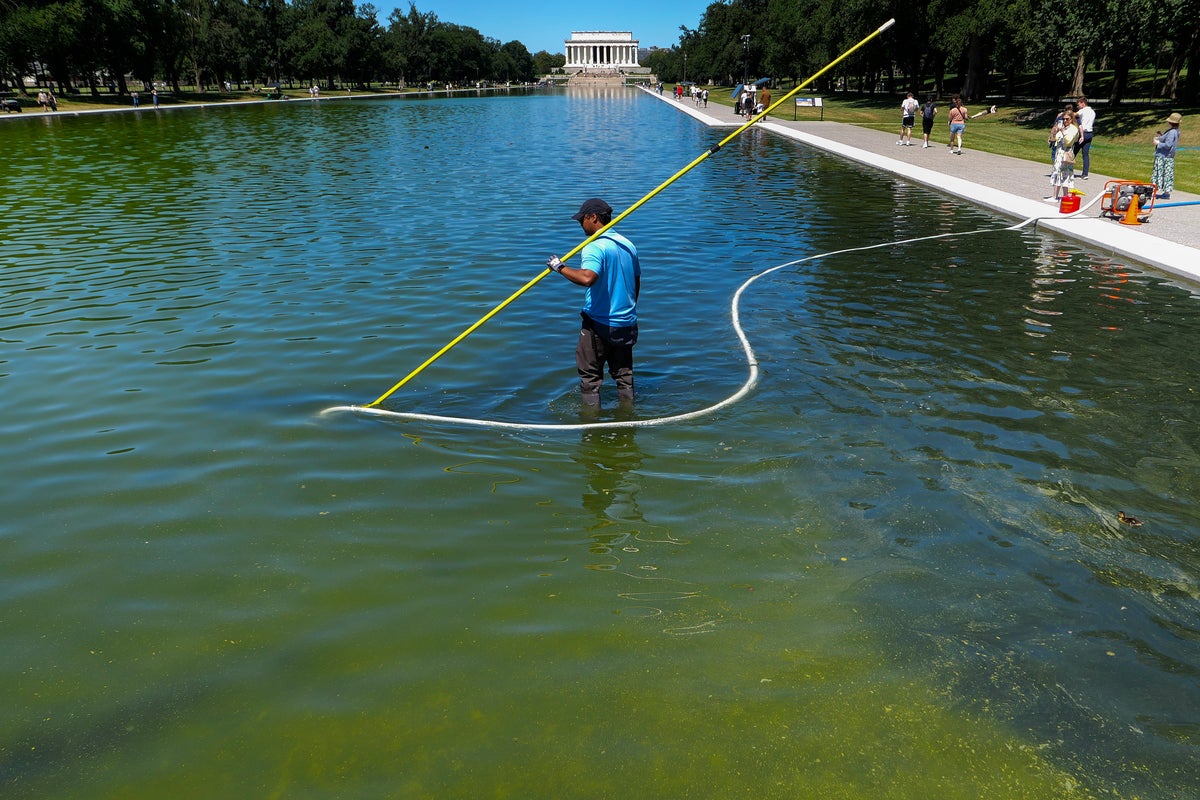
Yet, that's exactly what happened at the Lincoln Memorial Reflecting Pool. After Donald Trump ordered a rushed, multi-million-dollar renovation to turn the iconic water feature an "American flag blue" ahead of the nation's 250th birthday, the results didn't exactly match the hype. Within days of refilling the 2,000-foot-long basin, the pristine blue turned into a murky, pea-green soup. To top it off, massive sheets of the newly applied blue coating started delaminating, peeling away from the concrete floor and floating to the surface like dead skin.
Instead of looking at the obvious culprits—hasty workmanship, scorching summer heat, and the basic biology of stagnant water—the White House went on the offensive. Trump took to Truth Social to blast the "sick, deranged people" who allegedly sabotaged his masterwork, claiming vandals used knives and corrosive chemicals to destroy the pool.
The reality? It's a classic case of aesthetic overreach colliding with basic environmental science, wrapped up in a highly questionable government contracting drama.
The Chemistry Behind the Green Monster
Let's skip the political spin and look at the actual science. The administration spent over $14 million to overhaul the pool, which included a massive payout to Virginia-based Atlantic Industrial Coatings to apply the deep blue waterproof sealant. The logic seemed simple enough to the planners: blue paint equals blue water.
Nature doesn't care about logic. Open-air aquatic systems are incredibly volatile ecosystems. When you fill a massive, shallow concrete basin with hundreds of thousands of gallons of municipal water, you're introducing nutrients like phosphorus and nitrogen into a giant petri dish baking under the Washington sun.
Scientists who analyzed water samples from the pool identified a massive bloom of Scenedesmus, a standard genus of green algae. When sunlight hits those baseline nutrients, the algae replicates exponentially. The darker blue coating actually absorbs more heat than the standard weathered concrete, raising the water temperature and creating an absolute paradise for microscopic organisms.
The administration tried to fight back with an aggressive, tech-heavy cleanup campaign. National Park Service workers were seen throwing hydrogen peroxide into the water and deploying "advanced nanobubbler technology" to suffocate the bloom. While nanobubblers can temporarily suppress the phosphorus feeding the algae, water treatment experts note this is a band-aid, not a cure. Unless you change the filtration architecture or constantly poison the water with heavy chemicals, the green will always find a way back.
When Pool Maintenance Becomes a Felony
The most bizarre twist in the saga isn't the green water—it's the legal warfare happening on the banks of the National Mall.
As the public began snapping photos of the peeling paint and murky water, the White House narrative shifted entirely to sabotage. Interior Secretary Doug Burgum and federal prosecutors claimed vandals executed a coordinated attack, leaving a cumulative "350-foot gash" in the pool liner.
Enter David Hearn. The 67-year-old, three-time U.S. Olympian and former slalom canoeist was out for a bike ride when he stopped by the monument. Seeing a loose, rubbery strip of blue lining floating near the edge, he reached into the water to feel it. Within moments, U.S. Park Police and National Guard troops swarmed him.
Hearn was handcuffed, detained for five hours, and eventually slapped with a federal felony charge for the destruction of government property. U.S. Attorney Jeanine Pirro publicly accused Hearn of "forcefully and violently" ripping up the sealant with both hands. Hearn's legal team calls the charges an outrageous display of government overreach designed to protect a botched construction narrative.
Engineering experts point out that when a thick waterproof coating fails to bond correctly to old concrete, it forms giant bubbles and tears on its own. To an untrained eye—or a security camera—someone touching a piece of already detached liner looks exactly like someone tearing it up.
The Millions in No-Bid Contracts
Beyond the science and the arrests, there is the money. A coalition of Democratic lawmakers launched an investigation into how the contracts for this rush job were handed out.
Instead of going through the typical public consultation and competitive bidding processes required for historic landmarks, the administration used emergency-style declarations to fast-track the work. Ohio-based Greenwater Services scored a $1.7 million contract to install an upgraded filtration system. The catch? The company is tied to a trust led by John J. Cafaro, a major campaign donor.
When you bypass standard engineering reviews to meet a political deadline, you get exactly what happened here: a $14-plus million taxpayer-funded project that lasted less than two weeks before needing to be drained and repaired all over again.
What Happens Next
The administration confirmed they won't be seeking new bids to fix the mess. They are sticking with the original contractors to patch up the peeling liner, asserting that the workmanship wasn't the problem.
If you want to track how this project evolves, keep your eyes on the National Mall maintenance logs and federal court dockets over the coming months. The real test won't be the political rhetoric on social media, but whether the engineering teams can actually get the coating to stick before the basin has to be drained for yet another costly overhaul. For now, the civic mirror of the Lincoln Memorial remains a very expensive lesson in what happens when political branding ignores basic science.