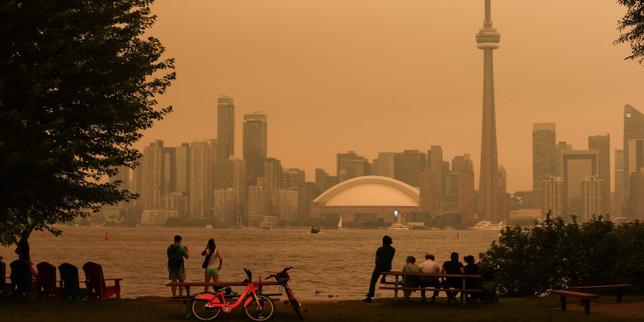
You step outside, expecting the fresh morning air of July, but instead, you are hit by a smell like campfire and a thick, yellow-orange haze that makes the CN Tower disappear. It is not a scene from a science fiction movie, though residents in Brampton and Mississauga have spent the last few days comparing the sky to the orange-tinted backdrop of Blade Runner 2049.
On July 15, 2026, Toronto officially recorded the worst air quality of any major city on Earth, beating out famously polluted capitals like New Delhi and Kinshasa.
This is not a freak accident. It is our new summer reality. The provincial capital was blanketed by a heavy shroud of toxic smoke carried down by northwesterly winds from massive forest fires burning hundreds of kilometers away in northwestern Ontario.
If you think this is just a temporary nuisance that you can ignore with a closed window, you are mistaken. The air quality health index (AQHI) peaked at 10+, which is the absolute maximum of the high-risk category. The concentration of fine particulate matter, known as PM2.5, spiked to an alarming 79.8 micrograms per cubic meter. That is more than 20 times the safety limit recommended by the World Health Organization.
We need to talk about what this smoke is doing to our bodies, why the official advice to "stay indoors" is hopelessly inadequate, and what needs to change if we want to survive the burning summers ahead.
When a Heatwave and Wildfires Collide
This week’s air crisis did not happen in a vacuum. It was supercharged by a relentless, record-shattering heatwave that has gripped southern Ontario.
The downtown core of Toronto reached a blistering 37.3 degrees Celsius, while tarmac temperatures at Toronto Pearson International Airport registered a melting 55 degrees Celsius.
When extreme heat combines with heavy wildfire smoke, it creates a dangerous dual-threat for your health. High temperatures force your heart to work harder to cool your body. At the exact same time, you are breathing in microscopic soot particles that enter your bloodstream, causing systemic inflammation.
Local officials scrambled to respond. They shut down outdoor public pools, canceled city-run summer camp programs, and even called off the massive FIFA Fan Festival outdoor viewing party scheduled for the England vs Argentina semi-final match.
But canceling soccer matches is a band-aid on a gaping wound. The real disaster is happening at the source of these fires, where entire communities are fighting for survival.
The Human Cost of the Northern Blazes
The smoke choking the streets of Toronto is coming from a network of over 100 active wildfires burning across northwestern Ontario. Of the hundreds of active fires burning across Canada right now, nearly 200 are classified as completely out of control.
While city dwellers complain about irritated eyes and raspy throats, indigenous communities in the north are losing everything. The fires forced hasty, chaotic evacuations in remote areas.
In Namaygoosisagagun First Nation, residents had only minutes to pack their lives before escaping across Collins Lake in small motorboats as towering columns of black smoke rose behind them. The small community of Collins, Ontario was almost entirely destroyed by the flames.
We also saw terrifying footage of a Canadian National railway crew near Armstrong, Ontario, trapped inside their train as a wall of fire swept across the tracks. The crew was thankfully evacuated, but the images of a train engulfed in a literal tunnel of flames show just how fast and violent these fires have become.
These are the fires feeding the orange cloud over southern Ontario and drifting across the border into New York, Michigan, and Pennsylvania.
The True Economic and Health Bill of Wildfire Smoke
Many people still treat wildfire smoke as a temporary weather event. We wait for the wind to shift, hoping the blue skies will return, and then we go back to business as usual.
The data tells a much darker story.
According to a comprehensive study by the Canadian Climate Institute, exposure to wildfire smoke is linked to roughly 2,500 premature deaths in Canada every single year.
Breathing in PM2.5 is not like breathing in campfire smoke. These microscopic particles bypass your lung's natural filtration systems, lodging deep inside your alveoli and crossing directly into your cardiovascular system. Over time, this leads to chronic respiratory diseases, heart attacks, strokes, and lung cancer.
The economic toll is equally staggering. The same study revealed that between 2014 and 2025, the total cost of wildfire smoke to the Canadian economy reached 231 billion dollars. That is an average of 19 billion dollars every year, driven mostly by long-term chronic illness and premature mortality.
When you look at those numbers, the traditional provincial fire budgets look like pocket change. We are paying for our inaction with our health and our tax dollars.
Why Stay Indoors is Often Bad Advice
When the sky turns yellow, Environment Canada and local public health units issue the same generic warning: "Stay indoors, keep your windows closed, and avoid strenuous activity".
That advice works if you live in a modern, sealed condo with a high-end HVAC system equipped with MERV 13 filtration.
But if you live in an older Toronto apartment building, a drafty home, or a house without central air conditioning, staying indoors can actually make you sicker.
Without proper filtration, indoor air quality quickly matches outdoor air quality. Even worse, if you close all your windows during a 37-degree heatwave without air conditioning, you risk severe heat exhaustion or heat stroke.
We need to stop giving oversimplified advice and start talking about real, actionable solutions.
How to Actually Protect Your Lungs
If you want to protect yourself and your family during these smoke events, you must take control of your immediate environment. Here is what actually works.
Upgrade Your HVAC Filter
If you have central heating and cooling, do not run it on "Auto." Set the fan to "On" so the air is constantly being filtered. Swap out your cheap fiberglass filter for a MERV 13 or higher rated filter, which is dense enough to capture the microscopic PM2.5 particles found in wildfire smoke.
Build a DIY Air Purifier
If you cannot find or afford an expensive HEPA air purifier, you can build a highly effective alternative for about forty dollars. It is called a Corsi-Rosenthal box. All you need is a standard 20-inch box fan, four MERV 13 furnace filters, and some duct tape. Tape the filters into a cube with the fan on top blowing upward, and seal the bottom with cardboard. This simple device filters air faster than many commercial units.
Ditch the Cloth Masks
A cloth mask or a standard blue surgical mask will do almost nothing to protect you from wildfire smoke. These masks are designed to stop droplets, not microscopic soot. If you have to spend time outside, you need a tightly fitted N95 or KN95 respirator mask. Ensure there are no gaps around your nose and chin.
Run Your AC on Recirculate
If you are driving or using a window AC unit, make sure it is set to "Recirculate." You do not want the machine pulling the toxic outdoor air directly into your living space or your car cabin.
The Boundaryless Threat of Wildfire Smoke
The smoke over Toronto does not care about provincial boundaries or international borders.
As the plume drifted south, air quality alerts were triggered across Michigan, Wisconsin, Minnesota, and New York. City officials in New York warned residents to prepare for hazy skies and spikes in fine particulate pollution.
This is a stark reminder that forest management and climate policy are not local issues. What happens in the isolated forests of northwestern Ontario directly impacts the health of millions of people living in the high-density urban corridors of northeastern North America.
We are dealing with a systemic crisis that requires rapid coordination. We must invest heavily in forest fire prevention, controlled burns, and rapid-response firefighting infrastructure.
Until we address the root causes of these massive, uncontrolled blazes, the yellow skies will keep coming back, summer after summer.
Your best defense right now is preparation. Check the local AQHI readings daily, keep your respirator masks handy, and make sure your indoor spaces are equipped to filter out the toxins. Do not wait for the government to tell you the air is dangerous. Look out the window, protect your lungs, and adapt to the reality of the smoke era.