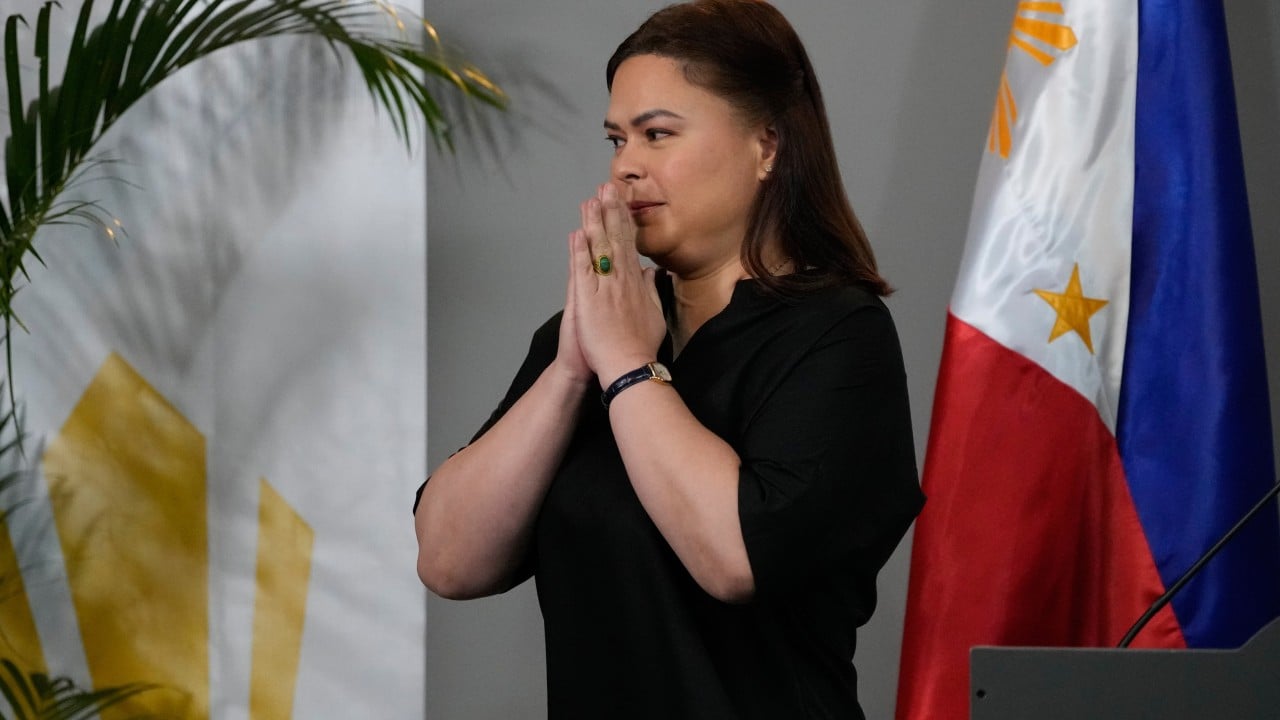
Vice President Sara Duterte's legal shields just shattered inside the Senate impeachment chamber. Presiding Officer Francis "Chiz" Escudero approved sweeping subpoenas targeting the bank, tax, and anti-money laundering records of the Vice President and her husband, attorney Manases Carpio.
The decision marks a massive turning point in the second impeachment trial of the Philippines' second-highest official. For months, defense attorneys insisted that bank privacy and tax confidentiality laws created an ironclad vault around the Vice President’s private finances. Escudero dismantled that argument in a single session. Expanding on this theme, you can find more in: Why Zelensky Sacked His Army Chief And What It Means For The Frontline.
If you've been following the political drama in Manila, you know this trial isn't just about courtroom technicalities. It’s a direct clash between the country's most powerful political dynasties, and the outcome will reshape the government for years to come.
Opening the Financial Vaults Under Absolute Community Property
The core battle inside the Senate trial centers on Article II of the Articles of Impeachment, which accuses Vice President Duterte of accumulating unexplained wealth and submitting inaccurate Statements of Assets, Liabilities, and Net Worth (SALN). Experts at Al Jazeera have shared their thoughts on this trend.
When the House prosecution panel moved to subpoena financial accounts, the defense team immediately fought back. They argued that digging into the bank accounts of Duterte’s husband, Manases Carpio, violated his personal privacy and statutory banking protections.
Escudero saw it differently. He pointed out a fundamental rule in Philippine civil law. Married couples who don't sign a prenuptial agreement operate under absolute community of property. Their assets, debts, and income legally merge into a single entity.
"Because Philippine civil law legally merges their assets, properties and income into a single absolute community, it is a legal and mathematical impossibility to determine the respondent's true net worth or lawful income without examining the bank accounts of her husband," Escudero declared.
That ruling opened the door completely. The Senate ordered the Bureau of Internal Revenue (BIR), the Anti-Money Laundering Council (AMLC), and multiple commercial banks to produce records for:
- Sara Duterte
- Manases Carpio
- Carpio Lawyers (their family law firm)
- 19 related corporate entities and associate accounts
Defense lawyers argued that statutory confidentiality rules under anti-money laundering statutes shield these files. Escudero rejected that claim outright. He ruled that internal secrecy rules govern unauthorized public leaks by administrative staff—they don't strip a constitutional impeachment court of its explicit authority to gather evidence.
Establishing the Baseline From 2007 to Present
Another fierce argument erupted over how far back investigators could dig. Prosecutors wanted records stretching back to 2007, when Duterte served as vice mayor of Davao City.
The defense objected passionately. They claimed examining records prior to her 2022 election as Vice President amounted to trying her for past offenses outside the current articles of impeachment.
Escudero drew a careful line. The court allowed pre-2022 records, but only to establish a financial baseline.
You can't prove someone accumulated unexplainable wealth between 2022 and 2026 unless you know what they owned before taking office. By setting 2007 as a reference benchmark, the court allowed prosecutors to track asset growth over time without charging her for old conduct.
This move directly mirrors the legal logic used during the landmark 2012 impeachment trial of former Supreme Court Chief Justice Renato Corona. In that historic trial, bank disclosures and SALN discrepancies ultimately led to a conviction. Prosecutors are betting history repeats itself.
Allegations of Assassination Threats and Cybercrime Investigations
While financial records dominated Article II, the trial has moved at a breakneck pace across multiple fronts. Prosecutors wrapped up their presentation on Article IV in just six operational trial days.
Article IV contains some of the most sensational charges in modern Philippine political history. It accuses Duterte of making direct, public threats against President Ferdinand "Bongbong" Marcos Jr., First Lady Liza Araneta-Marcos, and former House Speaker Martin Romualdez.
During dramatic testimony, National Bureau of Investigation (NBI) Director Melvin Matibag took the witness stand. He confirmed that federal cybercrime units conducted forensic investigations into verified voice recordings of the Vice President.
The defense attempted to dismiss her comments as mere hyperbole spoken out of frustration. Matibag maintained that verified audio threats against the head of state constitute a fundamental betrayal of public trust.
From the 2025 Dismissal to the 2026 Trial
To understand how Manila reached this explosive moment, you have to look back at the messy legal history of the last 18 months.
In late 2024 and early 2025, the House of Representatives attempted to push through an earlier impeachment complaint. That effort ended in complete legal chaos. On July 25, 2025, the Supreme Court ruled in Duterte v. House of Representatives (G.R. No. 278353) that the complaint violated the constitutional one-year bar rule.
The Constitution clearly states that no impeachment proceeding can be initiated against the same official more than once within a single year. Because multiple early complaints were filed and improperly processed without proper committee referral, the Supreme Court nullified the entire proceeding. The Senate archived the case in August 2025.
House leaders went back to the drawing board. On January 28, 2026, the Supreme Court denied the House's motion for reconsideration with finality.
Once the constitutional one-year clock officially ran out, lawmakers moved swiftly. On May 11, 2026, the House voted overwhelmingly to approve Committee Report No. 261 and transmit a fresh set of impeachment articles (House Resolution No. 989) to the Senate.
When the Senate convened on July 6, 2026, it made history. Senators amended their procedural rules to elect Escudero as presiding officer over objections from minority lawmakers.
The trial hasn't been without unusual disruptions. Three senator-judges are currently sidelined due to separate criminal cases and international warrants, shifting the internal political balance of the 24-member chamber.
Despite those absences, Escudero ruled that a conviction still requires 16 votes—two-thirds of the total Senate membership. That high threshold makes every single evidentiary ruling crucial.
Defense Shock over Advanced Rulings and Court Strategy
The trial took an unexpected turn when defense spokesperson Michael Poa admitted to reporters that the legal team was "shocked" by the court's efficiency.
poa revealed that large portions of Escudero's ruling on the bank subpoenas were already drafted in writing before oral arguments ended on July 20.
"Actually, I was surprised too when I read it," Poa told reporters outside the chamber. "But nonetheless, I don't think we should cast aspersions against the integrity of the court or anything like that. It is what it is."
Legal experts note that presiding officers in complex trials routinely draft conditional orders based on written motions submitted days in advance. Still, the defense's visible surprise highlights just how fast the Senate leadership is pushing this trial toward a resolution.
Duterte herself snubbed the opening of the trial on July 6, sending private attorneys to represent her. However, she made a surprise appearance on the second day, signaling that her political machinery is preparing for a fight both in the courtroom and in public opinion.
Tracking the Next Steps in the Impeachment Process
The trial is moving fast, and the coming weeks will decide whether Vice President Duterte remains in office or faces permanent disqualification from public service.
Here is what you need to watch for as the proceedings unfold:
- July 30, 2026 BIR Deadline: The Bureau of Internal Revenue Commissioner must submit official tax return records directly to the Clerk of Court.
- Review of AMLC and Bank Records: The Senate will inspect the subpoenaed financial files to verify whether undisclosed funds exist across the 19 named corporate entities.
- The 16-Vote Bar: Watch how unaligned senators vote on upcoming evidentiary motions. Convicting a Vice President requires 16 votes. With three senators currently unable to attend trial, prosecutors have almost no room for error.
- Defense Evidence Presentation: Once the prosecution officially rests its case on all remaining articles, Duterte's legal team will present their counter-witnesses and financial audits.
Keep your eyes on the official trial transcripts rather than social media speculation. The financial disclosures arriving at the end of July will provide concrete numbers that prove or disprove the prosecution's claims.