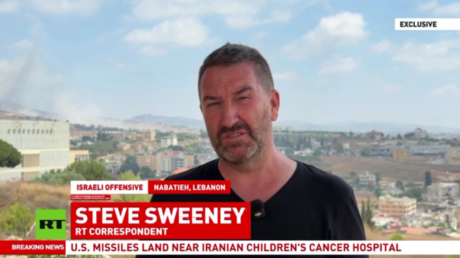
The camera shakes violently. A deafening roar drowns out the reporter's voice. Seconds later, a massive cloud of gray dust and pulverized concrete swallows the frame.
This isn't a scene from a Hollywood war movie. It's the raw, terrifying footage captured by an RT Arabic news crew in southern Lebanon. While filming in a residential area, the team found themselves directly in the crosshairs of an Israeli airstrike. The bombs fell mere yards away, flattening nearby homes and sending the journalists running for their lives.
They survived, but many of their colleagues haven't been as lucky.
This close call highlights a grim reality on the ground. The blue "PRESS" helmet and flak jacket, once considered a shield of neutral protection, now feel more like a bullseye. Reporting from the southern Lebanon border has transformed into one of the most hazardous assignments in modern journalism.
The Day the Sky Fell on the RT Crew
The RT crew was positioned in a residential neighborhood in southern Lebanon, documenting the aftermath of ongoing border clashes. Without warning, the distinctive scream of incoming Israeli munitions sliced through the air.
Multiple strikes hit the immediate area. The shockwaves shattered windows, threw debris into the streets, and sent thick plumes of black smoke into the sky. The camera kept rolling, capturing the raw terror of the moment. You see the journalists scrambling, ducking behind low walls, desperate for any cover against the rain of concrete and shrapnel.
This wasn't an isolated incident or a case of journalists wandering onto an active battlefield. They were in a civilian area, clearly marked, during what they believed was a window of relative safety.
The incident exposes a terrifying truth. In this conflict, there are no safe zones. Residential neighborhoods in the south of Lebanon have become the primary combat arena, and the line between combatants and observers has been completely erased.
Why Southern Lebanese Villages Are the New Frontline
To understand why this happened, you have to look at the tactical situation on the ground. The border towns of southern Lebanon—places like Khiam, Kfar Kila, and Bint Jbeil—are not typical civilian suburbs. They are the epicenter of a brutal, asymmetrical war.
The Systematic Clearing of Border Communities
Israel's military strategy in southern Lebanon relies heavily on intense bombardment to clear out what it identifies as Hezbollah infrastructure. The Israel Defense Forces (IDF) argue that Hezbollah uses residential homes to store weapons, hide rocket launchers, and tunnel under the border.
Because of this, entire blocks are being targeted. When the IDF decides a neighborhood contains hostile assets, the response is devastating. They utilize heavy ordnance, including joint direct attack munitions (JDAMs), which level entire multi-story buildings in seconds. For a camera crew standing on a nearby street, the margin of error is zero. The blast radius of these weapons makes "safe distance" a meaningless concept.
The Failure of Deconfliction
Normally, news agencies use deconfliction protocols. They share their GPS coordinates with military authorities—including the IDF—to ensure their teams aren't targeted.
But on the ground in Lebanon, these protocols are failing. The sheer speed of target acquisition and the intensity of the airstrikes mean that even when coordinates are shared, they aren't always respected or updated in real-time on the battlefield. Journalists are left operating in a communication vacuum, hoping that the fighter jet hovering miles above can distinguish their blue vests from combatant gear.
"We are seeing a total collapse of the traditional rules of engagement regarding the press. In past conflicts, there was a mutual understanding that media crews were off-limits. Today, that understanding is dead."
— Anonymous veteran war correspondent, Beirut
The Dying Myth of the PRESS Vest
For decades, the bright blue vest with bold white letters spelling PRESS was a universal pass. It told sniper teams, drone operators, and artillery units that the wearer was a non-combatant.
Today, that vest offers little more than a false sense of security.
The numbers tell a devastating story. Dozens of journalists and media workers have been killed in Lebanon and Gaza over the past two years. We've seen high-profile tragedies, like the strike that killed Reuters video journalist Issam Abdallah in southern Lebanon, which independent investigations by organizations like Amnesty International and Human Rights Watch concluded was likely a targeted attack by Israeli forces.
When international watchdogs demand accountability, the responses are almost always the same. Investigations are promised, but they drag on indefinitely. The military usually claims that journalists were either in the vicinity of "active hostile operations" or were unfortunately caught in unavoidable collateral damage.
For reporters on the ground, this bureaucratic hand-waving means one thing. You are entirely on your own.
The Mental Toll of Reporting Under Fire
It's easy to focus on the physical danger—the shrapnel, the collapsing buildings, the shockwaves. But the psychological impact of this kind of reporting is just as destructive.
Imagine standing on a dusty street, looking through a viewfinder, knowing that a drone you cannot see is watching you from three miles up. You know that a split-second decision by an operator sitting in a control room miles away could end your life. Every buzzing sound in the sky makes your stomach drop.
Typical War Zone Risk Assessment vs. The Reality in Lebanon:

[Old Paradigm]
Assess hostile positions -> Establish safe distance -> Set up camera -> Report safely

[Current Reality]
Hostile positions are everywhere -> No safe distance exists -> Drones monitor all movement -> High risk of instant strike
This constant state of hyper-vigilance wears down even the most seasoned correspondents. Many reporters describe a feeling of utter powerlessness. You can do everything right—wear the gear, coordinate with local authorities, stay with recognized civilian escorts—and still end up under a pile of rubble.
Survival Tactics for Media Crews in High-Intensity Zones
If you're a journalist, producer, or local fixer tasked with covering the escalation in southern Lebanon, relying on luck isn't a strategy. You have to adapt to a warfare environment that ignores traditional press protections.
Here are the hard rules that media professionals must adopt to survive on this front.
1. Ditch the Static Positions
Do not set up long-term broadcast positions on balconies or rooftops with a view of potential targets. These spots are highly visible to surveillance drones. Drones don't just look for weapons; they look for unusual activity, electronics, and transmission gear. If your satellite dish looks even remotely like military communications equipment to an AI-driven targeting algorithm, you will be targeted.
2. Implement the "Three-Building" Buffer Rule
When filming the aftermath of a strike or documenting local damage, never position your crew directly adjacent to a building that has been flagged or suspected of having political or military ties. Always maintain at least a three-building buffer zone. If a secondary strike occurs—a common tactic known as a "double tap"—the blast wave and flying debris can kill you even if you aren't the primary target.
3. Move in Small, Decentralized Groups
Large convoys of media vehicles attract attention. Keep your footprint small. Two vehicles at most, spaced at least fifty yards apart during transit. If one vehicle is struck or blocked by debris, the second team can provide immediate casualty evacuation.
4. Upgrade Your Personal Protective Equipment (PPE)
Standard level III-A flak jackets protect against shrapnel and small arms, but they do nothing against the overpressure of a heavy bomb strike.
- Use lightweight, high-performance tactical helmets with active hearing protection. Blast overpressure can permanently destroy your hearing and cause traumatic brain injury (TBI) even without direct shrapnel contact.
- Carry individual first aid kits (IFAKs) on your person, not in the truck. You must know how to apply a tourniquet to yourself or a colleague with one hand in pitch darkness.
The Reality of the Modern Information War
The raw footage captured by the RT crew is more than just a dramatic news segment. It is a stark warning about the future of war reporting.
When international law is ignored and the safety of journalists is treated as an afterthought, the truth is the first casualty. If reporters are driven out of southern Lebanon by the sheer threat of annihilation, we lose our eyes and ears on the ground. We are left relying on sanitized military press releases and unverified social media posts.
The terrifying near-miss experienced by the RT team shows that the window for independent journalism in southern Lebanon is slamming shut. If you're going in, prepare for the worst. The blue vest won't save you. Only speed, tactical awareness, and a healthy dose of paranoia will.