The image flashed across Iranian state television for only a few moments, but it was more than enough to trigger a frenzy.
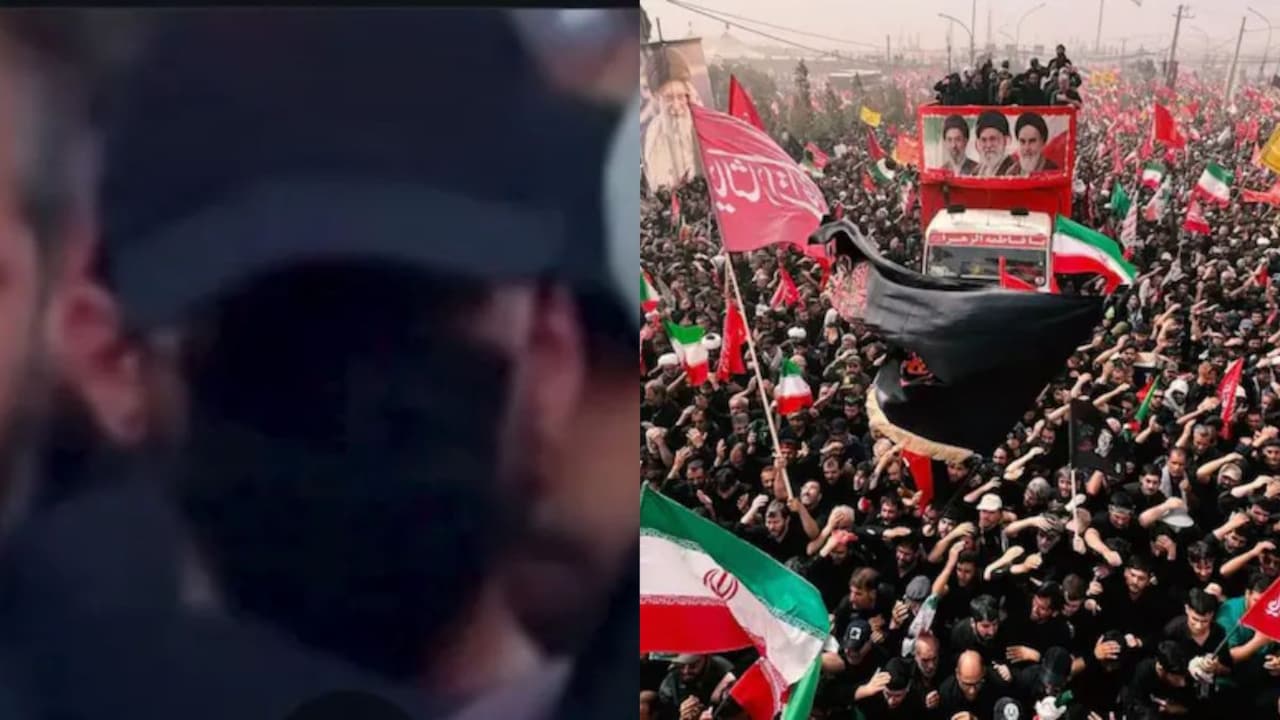
During the private, tightly guarded funeral prayers for the slain Supreme Leader Ali Khamenei in Mashhad, a figure stood in the front row that did not fit the traditional clerical mold. He wore a black baseball cap. A thick black mask completely obscured his face. He stood shoulder to shoulder with the late leader's family, deep within the inner sanctum of the regime. Read more on a connected topic: this related article.
Within minutes, the internet exploded with theories. Millions of Iranians and foreign intelligence analysts thought they were looking at Mojtaba Khamenei.
Mojtaba, the son of the dead Ayatollah, had been fast-tracked into the position of Supreme Leader by a clerical assembly just days after his father was killed in the massive February 28 US-Israeli airstrikes. Yet, for over four months, Mojtaba had been a ghost. No public appearances. No television broadcasts. No voice recordings. His complete disappearance led critics to mockingly label him the "cardboard Ayatollah." More reporting by USA Today highlights related views on this issue.
The logic seemed airtight. The regime needed to show its new leader was alive, but security threats or severe injuries forced him to attend his father's final burial in disguise.
It was a brilliant narrative. It was also completely wrong.
The mystery of the masked man at the Khamenei funeral has finally been solved, and the reality tells a far more tragic, complicated story about the true state of the inner circle in Tehran.
The Identity Behind the Black Mask
The masked figure was not Iran's new Supreme Leader. Iranian state-aligned news outlets, alongside independent monitoring groups like Iran International, confirmed that the man in the baseball cap was actually Mohammad Javad Khamenei.
He is the eldest grandson of the late Ayatollah and the son of Mostafa Khamenei, who led the funeral prayers.
The reason for the heavy mask and the baseball cap was not a high-stakes game of political hide-and-seek. It was a matter of survival and severe physical trauma. Mohammad Javad was present at the supreme leader’s residence on February 28 when the bombs fell. While his grandfather was killed, the grandson survived the blast but suffered devastating facial injuries and severe burns.
The mask was worn to protect and cover his disfigured face, not to hide a political transition.
This revelation strips away the cinematic spy thriller theories, but it replaces them with a stark reality. The blast that killed Ali Khamenei shattered his immediate family. The individuals who survived are carrying deep, physical scars that they cannot hide from public view without extreme measures.
Why Everyone Blundered the Identification
You cannot blame the public or the intelligence community for jumping to conclusions. The environment surrounding the six-day state funeral was an absolute pressure cooker of propaganda, grief, and geopolitical tension.
State media claimed up to 43 million people flooded the streets across Iran and Iraq to witness the multi-city funeral procession. The bodies traveled from Tehran to Qom, then to the holy Iraqi cities of Najaf and Karbala, before finally returning to the Imam Reza shrine in Mashhad. The regime went all out to turn the burial into an unmatched display of religious martyrdom and national unity.
They wanted to show complete control. But the glaring absence of Mojtaba Khamenei ruined the script.
When a regime demands absolute loyalty to a new leader who refuses to show his face, the public fills the silence with rumors. Pro-government journalists had spent days hinting that Mojtaba would slip into the crowd to mourn his father. Artificial intelligence videos even began circulating online, showing fake depictions of Mojtaba walking among the crowds in civilian clothes.
When the state broadcaster accidentally or intentionally showed a man matching Mojtaba's general height and build standing right next to the coffin in a mask, the puzzle pieces seemed to fall perfectly into place.
It looked like the ultimate confirmation that the new leader was functioning, even if he had to hide behind protective gear. The truth broke the illusion. The new Supreme Leader was still nowhere to be found.
The Real Crisis the Masked Man Exposed
The obsession with the masked man points to a much larger, structural vulnerability within the Iranian state. The Islamic Republic is facing an unprecedented succession crisis, and the regime is struggling to manage the optics.
Think about the timeline. Mojtaba was named Supreme Leader in early March. Since then, his rule has been defined entirely by text. He releases written statements on Telegram, including a recent letter vowing to exact swift revenge against the United States and Israel for his father's death.
But text does not inspire confidence when the country is dealing with wartime inflation, a crippled banking system, and the threat of further military strikes.
Western intelligence reports suggest that Mojtaba was also severely wounded and disfigured in the February 28 attack. The Islamic Revolutionary Guard Corps (IRGC) recently tried to quiet the rumors by releasing a fresh photograph of Mojtaba wearing his traditional turban and glasses, claiming he is in excellent health. The photo failed to convince anyone. It looked highly staged, lacking any clear context of time or location.
The fact that the regime had to rely on a questionable photograph while a masked grandson was being mistaken for the leader at the most important state funeral in decades shows how desperate the information war has become.
The IRGC is terrified. They cannot afford to show a weak, visibly injured, or deeply traumatized leader to a population already on the edge of revolt. They also cannot guarantee his safety. Reports indicate the IRGC vetoed Mojtaba’s requests to attend the funeral in the open because they could not guarantee 100% security against another strike.
How to Read Between the Lines in Tehran
If you want to understand where Iran is heading next, you have to stop looking for hidden clues in the crowd and start looking at the structural shifts within the regime. The masked man saga teaches us exactly how to filter the noise coming out of the Middle East right now.
First, ignore the crowd counts. State media’s claim of 43 million mourners is an obvious exaggeration designed to project domestic legitimacy. Focus instead on where the burial took place. Choosing the Imam Reza Shrine in Mashhad was a calculated political move. Imam Reza is a symbol of tragic martyrdom in Shia Islam. By placing Ali Khamenei there, the leadership is attempting to permanently tie the state’s political survival to core religious faith.
Second, watch the format of communication. Until Mojtaba Khamenei delivers a live, unedited video address, assume the leadership transition is deeply unstable. A regime that rules through Telegram messages is a regime operating from a bunker.
Keep your eyes on the internal power struggles between the traditional clerical establishment and the IRGC military commanders. The longer the Supreme Leader remains a shadow, the more power shifts directly into the hands of the generals running the security apparatus. They are the ones actually making the decisions while using the family name as a shield.
The mystery of the masked man is officially over. But the deep, structural instability it brought to light is just getting started.
Watch the state television broadcasts closely over the next few weeks. The regime will have to find a way to bring their new leader into the light, or risk letting the rumors completely erode what remains of their authority. Let's see how long they can keep ruling from the shadows.
_03.jpg)