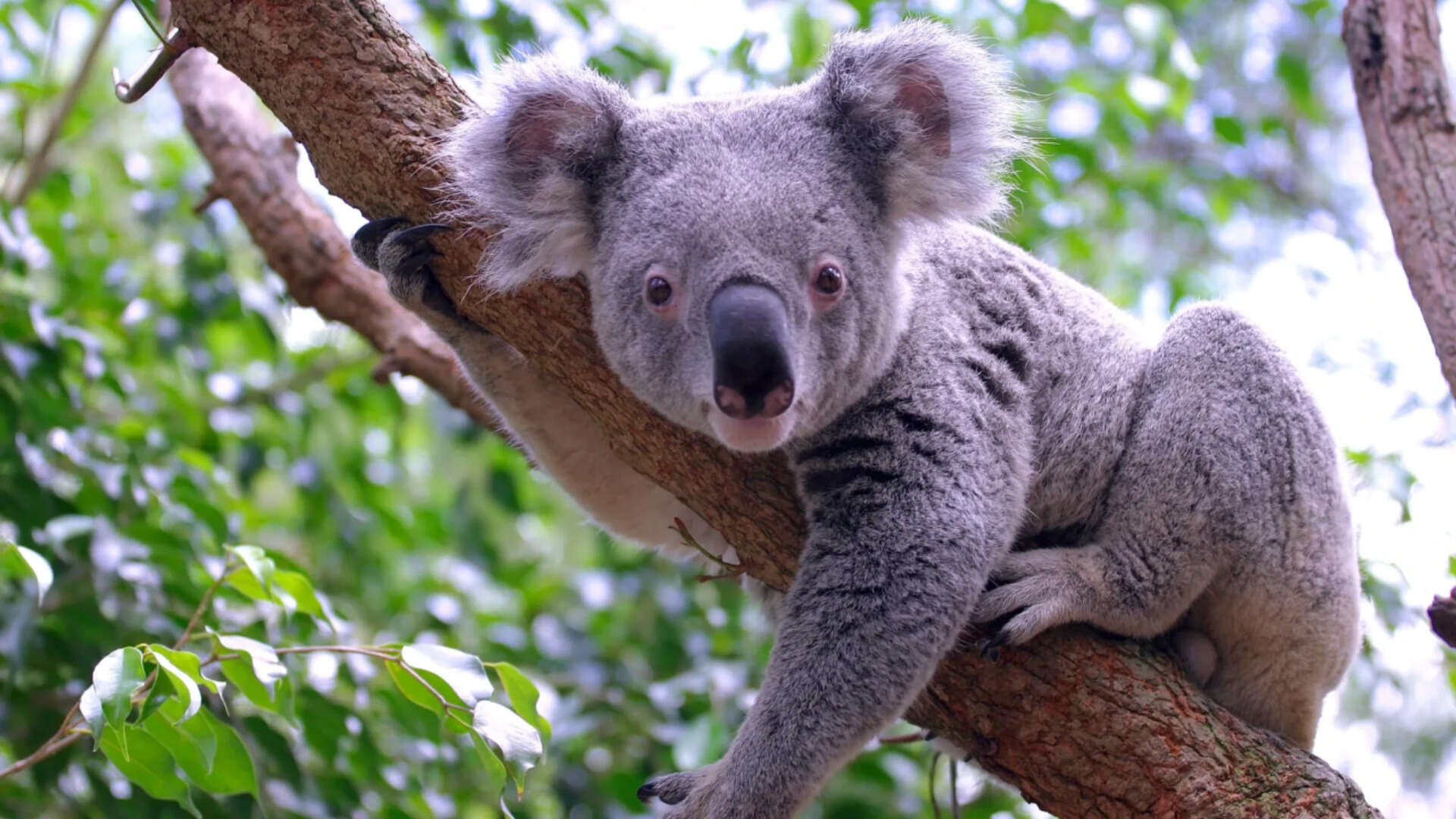
Stop blaming early humans for every ancient animal disaster. For years, the dominant story about Australia's most famous marsupial followed a familiar, depressing script. The narrative claimed that when modern humans arrived on the continent around 65,000 years ago, our ancestors quickly drove the vulnerable koala population off a cliff.
It turns out that history is flat wrong.
A massive genomic study published in the journal Molecular Biology and Evolution completely blows up that timeline. By looking deep inside the DNA of 457 wild koalas, an international research team discovered that the species suffered a catastrophic population crash about 100,000 years ago. That is roughly 40,000 years before a single human foot ever touched Australian soil.
The real culprit was a wildly unstable climate. Severe ice ages and a rapidly drying continent pushed these animals to the absolute brink. Every single koala chewing on a eucalyptus leaf today is the descendant of a tiny, incredibly resilient group of survivors that managed to cling to life in the eastern forests.
We need to understand how scientists uncovered this hidden past and why it changes how we protect the species today.
The Problem With Borrowed Science
To understand why our old timeline was so broken, you have to look at how biologists used to track ancient history. Fossils from the late Pleistocene period are incredibly rare. Koalas spend their lives in trees, and their bones do not fossilize easily. Without a thick pile of old bones to dig up, scientists had to rely on a genetic clock.
Every living creature accumulates minor genetic mutations over generations. If you know the exact rate at which these mutations happen, you can count the differences between modern genomes and trace a species back in time. You can estimate when a population grew, when it shrank, and when different groups split apart.
But for decades, scientists lacked a critical piece of data. They did not know the actual mutation rate of koalas.
Instead of measuring it directly, researchers did what science often forces people to do. They guessed. They borrowed mutation rates from distantly related mammals, mostly humans and mice.
Using human or rodent genetic clocks to measure a marsupial is a terrible idea. It assumes all mammals evolve at the same speed. This flawed shortcut heavily skewed our historical models. It squeezed thousands of years of natural, slow-moving climate struggles into a single, sudden collapse that perfectly overlapped with early human migration. It made a natural climate crisis look like human overhunting.
Cracking the Marsupial Genetic Clock
The new study changed everything by throwing out those borrowed numbers. Led by researchers at the University of Sydney and Texas A&M University, the team decided to calculate the first-ever species-specific mutation rate for koalas.
To do this, they sequenced the complete genomes of four parent-offspring trios. By comparing the DNA of mother and father koalas directly to their babies, the team could physically count the brand-new mutations that appeared in a single generation.
The results were stunning. The koala genetic clock runs incredibly slow. It ticks at about half the speed of the human genetic clock.
When you realize the genetic clock is running at half-speed, your entire view of the past shifts. Events you thought happened 50,000 years ago actually happened 100,000 years ago. Armed with this corrected clock, lead author Toby Kovacs and his team applied the new mutation rate to 457 whole-genome sequences collected from wild koalas across their entire modern range.
The historical map redrew itself immediately.
A Continent Drying Out
The corrected data shows the koala population began a long, painful downward slide around 100,000 years ago. The species hit a brutal genetic bottleneck nearly 60,000 years ago.
This timeline perfectly matches a period of extreme environmental upheaval during the late Pleistocene. Millions of years ago, Australia was a lush, wet paradise covered in thick rainforests. But as the Australian tectonic plate drifted steadily northward, the interior of the continent grew increasingly arid.
During the Pleistocene, the planet started swinging violently between cold, dry ice ages and brief, warmer intervals. For koalas, who rely entirely on specific eucalyptus trees for food and hydration, this drying trend was a death sentence.
Around 70,000 years ago, the environment shifted dramatically. The Nullarbor Plain expanded, transforming into a massive, semi-arid shrubland. This geographical barrier acted like a giant wedge. It completely sliced the Australian koala population into two isolated groups, one in the west and one in the east.
The western koalas could not cope with the shrinking forests. As the land dried out and massive bushfires became a regular feature of the environment, the western population vanished entirely. They left behind no living descendants.
The Tough Survivors of the East
The eastern koalas barely fared any better. Their numbers plummeted during the harshest glacial periods, squeezing the entire species through a tight genetic needle.
But a small, stubborn population managed to persist in the pockets of forest along the eastern coast. They endured intense cold, severe droughts, and a changing landscape that looked nothing like the lush forests of their ancestors. They were survivors.
When the climate finally stabilized and warmed during the current interglacial period, between 16,500 and 6,000 years ago, these eastern survivors began to reclaim their lost territory. As the forests expanded, this lone ancestral group spread out along the coast.
As they spread, they naturally separated into five distinct genetic populations. These five groups form the exact blueprint for the wild koalas we find today scattered throughout Queensland, New South Wales, and Victoria.
This means the current genetic diversity of the entire species was dictated by a climate crisis that happened millennia before modern human civilization even began.
Why This Matters for Conservation Right Now
This research is not just an interesting history lesson. It has massive implications for how we handle the current koala crisis.
Right now, koalas are in serious trouble. The species was officially listed as endangered across Queensland, New South Wales, and the Australian Capital Territory in 2022. They are facing a brutal combination of human-driven land clearing, severe bushfires, urbanization, and devastating outbreaks of disease like Chlamydia.
Some critics argue that because koalas survived massive climate shifts in the past, they can easily adapt to modern changes. That is a dangerous misunderstanding of the data.
The ancient population crash stripped koalas of a huge amount of their genetic diversity. When a species goes through a bottleneck that severe, it loses the genetic toolkit required to adapt quickly to new threats. The koalas we have today are already operating on a limited genetic budget.
By analyzing the last 100 generations of koalas, the research team showed how previous conservation models drastically misjudged population health. Using the wrong mutation rates meant conservationists were misinterpreting how fast populations were shrinking or recovering.
For instance, the modern picture is highly fractured. Koala numbers in Queensland and New South Wales are still dropping rapidly, while populations in Victoria are seeing a fragile recovery. Because we now have an accurate genetic clock, we can track these modern population shifts with incredible precision. We can spot when a specific group is losing genetic diversity long before the physical animals start disappearing from the trees. This allows wildlife managers to step in with targeted breeding programs or habitat protections before inbreeding ruins a population's chances of survival.
Next Steps for Saving Native Wildlife
This genetic breakthrough opens up an entirely new way to look at conservation across Australia. The research team is already planning to use this exact same approach on other native animals.
We need to apply this corrected genetic clock method to the closest living relatives of Australia's extinct megafauna. Wombats, kangaroos, and possums all belong to the same marsupial order, Diprotodontia. None of these species have ever had their direct mutation rates measured. We are likely misinterpreting the history of all these animals, blaming human arrival for population declines that were actually started by ancient climate shifts.
If you want to support this work or help protect the remaining habitats, look into organizations that fund localized genomic sequencing for wildlife, like the Australian Museum Research Institute. Advocate for conservation policies that focus on preserving the distinct genetic boundaries of the five remaining eastern koala groups. Stop treating the species as one massive, uniform population.
We now know exactly how hard these animals fought to survive the drying of a continent 100,000 years ago. They survived the ice ages against all odds. It would be a tragedy if we let them slip away now because we failed to understand their true history.