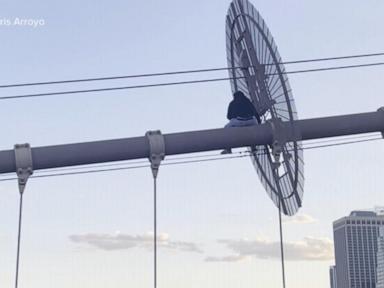
You have probably seen the viral footage by now. A 31-year-old woman is perched on a narrow steel beam of the Brooklyn Bridge, high above the churning waters of the East River. Below her, New York City traffic grinds to an absolute halt. Above her, a team of cops from the NYPD Emergency Service Unit tethers themselves to the bridge structure and slowly edges out onto the cold metal.
It is the kind of high-stakes spectacle that makes for perfect internet engagement. Local news stations run the clip on a loop, focusing heavily on the drama, the height, and the massive gridlock that choked the eastbound lanes on a Wednesday night. Expanding on this topic, you can also read: Why The New Us And Iran Clashes During Khamenei's Burial Matter.
But if you are only looking at the sheer height of the bridge or the traffic nightmare, you are missing the entire point of what happened out there.
The real story isn't the physical climb. It is what happened during the agonizing, silent hour before anybody pulled her back. Analysts at BBC News have provided expertise on this trend.
The Art of the Long Conversation
When a person climbs onto a structure like the Brooklyn Bridge, the immediate public reaction involves a lot of assumptions. People think it requires a cinematic, split-second tackle. They think someone just lunges forward and grabs the individual before they can react.
Real life doesn't work like that. If an officer rushes an individual in a severe mental health crisis, the sudden movement can trigger a fatal reflex. A single slip or a panicked jump changes a rescue into a tragedy in a fraction of a second.
Instead, the NYPD Emergency Service Unit relies on an entirely different mechanism. They talk. They wait. They build a bridge of words before they ever use a physical harness.
Reports from the scene indicate that officers spent nearly an hour out on that beam. Think about sitting on a narrow piece of rusted steel suspended over the East River for sixty minutes. The wind is constantly pulling at your gear. The noise of the city is loud. The pressure is immense. Yet, the bodycam footage captures a tone that sounds entirely normal, almost casual, given the circumstances.
An officer on the scene didn't yell commands. He didn't quote procedures. He repeatedly told her that everything was going to be fine. He looked her in the eyes and made a simple promise. You are not in trouble.
That phrase is crucial. When people find themselves on the edge of a bridge, they are often overwhelmed by a profound sense of shame, fear, or a belief that they have broken something that can't be fixed. They expect flashing lights, handcuffs, and anger. When they get absolute calm and a promise of safety instead, the entire dynamic shifts.
What Most Media Reports Completely Ignore
News broadcasts love to focus on the gear. They point out the tactical vests, the heavy-duty tethers, and the specialized rescue straps. They describe the unit as elite, which they are, but they frame that elitism around physical prowess and gear capability.
That framing is completely backward. The gear is just there to keep the cops from falling. The actual tool doing the work is basic psychological de-escalation.
The NYPD Emergency Service Unit goes through intensive psychological training for this exact reason. They are trained to match the energy of a person in crisis and slowly bring it down. If the person is frantic, the officer stays steady. If the person is silent, the officer speaks softly, filling the space with reassurance without demanding immediate answers.
In this specific case, the 31-year-old woman didn't immediately give up or climb down. She sat there. The officers stayed right beside her, anchored to the structure, matching her patience. They didn't rush the clock because the clock doesn't matter when a life is on the line. They waited for the exact moment where physical contact wouldn't feel like an attack.
When they finally moved to secure her, the action was deliberate and gentle. They didn't slam her down. They supported her weight, wrapped their arms around her, and guided her off the beam step by step.
The Reality of Post-Crisis Care
Another detail that gets buried under the headlines is what happens after the cameras stop rolling. The woman was not placed under arrest. She wasn't thrown into the back of a standard squad car to face criminal charges for disrupting the city.
Emergency medical services transported her directly to Woodhull Hospital for a full psychiatric evaluation. This is where the system actually functions the way it should. The bridge rescue is just stage one. The real work of stabilizing a human life happens in a hospital room, away from the sirens and the onlookers.
Too often, public discourse around police work focuses on the extremes of enforcement. This incident serves as a stark reminder of the massive volume of mental health work that municipal police departments handle every single day. It isn't glamorous. It doesn't always make the evening news unless it happens on a landmark like the Brooklyn Bridge. But it happens in back alleys, apartment buildings, and subway platforms every single shift.
The ultimate measure of success in these operations isn't a dramatic arrest record. It is a quiet ride to a hospital.
Next Steps for Improving Crisis Awareness
If you want to understand how to support crisis intervention in your own community, looking at major city rescues provides clear takeaways that apply far beyond the edge of a bridge.
First, normalize the idea that a mental health crisis requires patience, not immediate force or quick fixes. When someone you know is spiraling, your immediate instinct might be to offer a rapid solution or push them to get over it. Instead, take a page from the rescue team. Sit with them. Keep your voice level. Eliminate the fear of judgment or punishment.
Second, familiarize yourself with the actual resources available in your area. New York relies heavily on mobile crisis teams and specialized hospital transitions, but every region has different structures. Knowing the difference between calling standard emergency lines and calling a dedicated crisis line can completely alter the outcome of a local emergency.
The Brooklyn Bridge incident ended perfectly because a group of highly trained people treated a terrified human being like a person instead of a problem. That is the standard we need to expect across the board.