When an armored BMP infantry fighting vehicle smashed at full speed through a burning roadblock in Mariupol back in May 2014, flying through the air before speeding down the asphalt, nobody knew the major inside would one day run the entire Ukrainian military.
His driver had paused in front of the barricade, asking what they should do.
"Step on the gas," Mykhailo Drapaty said.
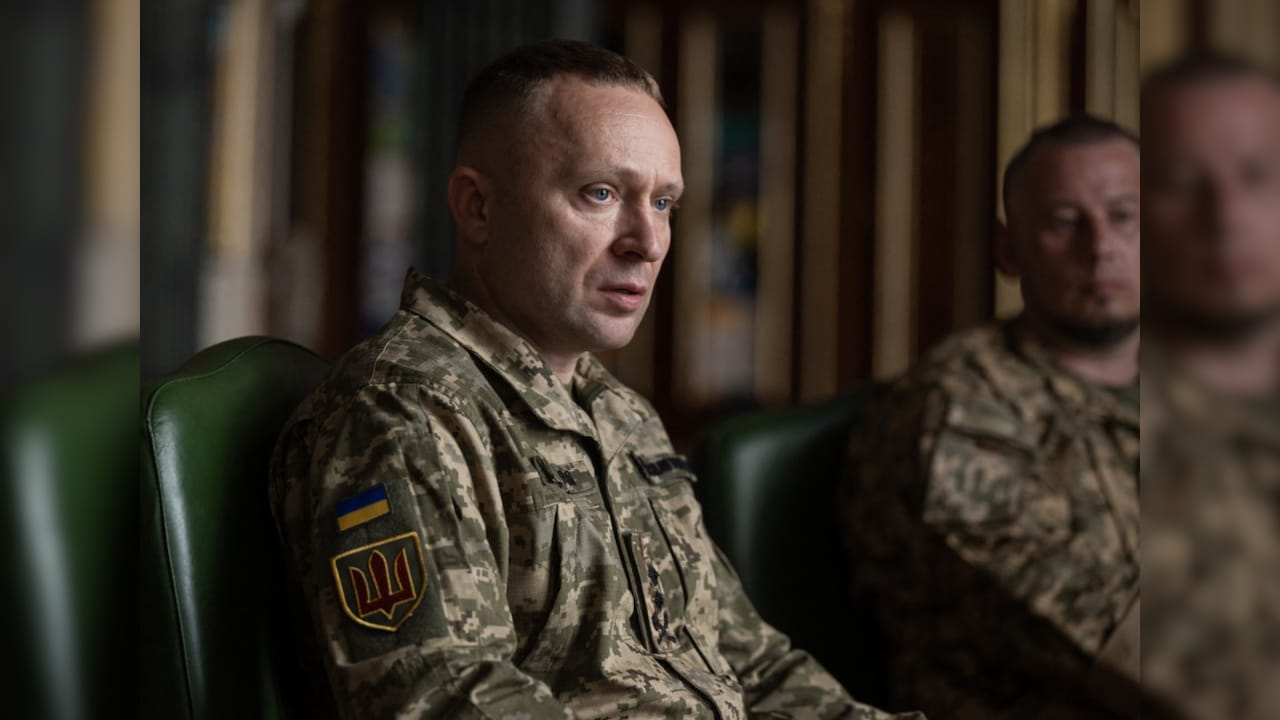
That viral clip defined him then. Today, Major General Mykhailo Drapaty takes command of the Armed Forces of Ukraine as Commander-in-Chief, stepping into the top job after Volodymyr Zelenskyy replaced Oleksandr Syrskyi following intense military and political debates.
If you want to understand where Ukraine's military is heading, you have to look past the political headlines in Kyiv. Drapaty isn't just another general moving up the chain. He represents a total break from rigid Soviet military culture.
From the Izvarin Cauldron to the Frontlines
Drapaty isn't a staff general who spent his career sitting behind desks in Kyiv. He was born in 1982 in Kamianets-Podilskyi and built his entire career inside Ukraine's post-independence military system. He graduated from the Kharkiv Institute of Tank Troops in 2004 and started at the bottom as a lieutenant in the 72nd Mechanized Brigade.
The war in 2014 tested him immediately.
While the famous Mariupol barricade incident made him a household figure, his real tactical triumph came months later during the infamous Izvarin Cauldron. Russian artillery pounded encircled Ukrainian positions from across the border. Panic set in among many units. Drapaty kept his cool, organized a tactical breakthrough, and successfully led 260 of his soldiers out of the trap.
That single operation taught him lessons about troop preservation that still shape his thinking today. He saw firsthand how tactical mistakes cost human lives.
During the quiet years between 2016 and 2021, while Western observers thought the war in Donbas was frozen, Drapaty was active on the frontlines near Avdiivka and Toretsk commanding the 30th and 58th Mechanized Brigades. By 2021, he graduated with honors from the National Defense University of Ukraine, receiving the British Queen's Sword from the British Ambassador as the top graduate in his class.
Defense of Kryvyi Rih and the Liberation of Kherson
When Russia launched its full-scale invasion in February 2022, Drapaty was thrust into crisis management on the southern front.
Assigned to lead the southern operational group, he commanded disorganized and severely outnumbered forces. His job was simple on paper but nearly impossible on the ground: stop the Russian advance toward Kryvyi Rih. He held a line stretching over 200 kilometers with limited reserves.
He stopped them.
By autumn 2022, Drapaty moved from defensive actions to offensive planning. He helped coordinate mechanized units pushing Russian forces back toward the Dnipro River. That campaign ended with the liberation of Kherson and roughly 2,000 square kilometers of territory.
Soldiers who served under him during those operations describe a commander who spent minimal time in headquarters. He frequently visited forward positions, inspected logistics, and listened directly to battalion commanders rather than relying on sanitized staff reports.
Why His Resignation in 2025 Changed Everything
In June 2025, an incident occurred that set Drapaty completely apart from traditional Ukrainian commanders.
While serving as Commander of the Ukrainian Ground Forces, Russian missile strikes hit a training facility in Dnipropetrovsk region, killing 12 soldiers and injuring dozens. The attack stemmed from security lapses and leaked locations regarding troop gatherings.
Instead of deflecting blame or scapegoating mid-level subordinates, Drapaty submitted his resignation.
"If we fail to draw conclusions, to change our attitude toward service, to acknowledge our mistakes, we are doomed," he publicly stated.
In a military apparatus historically influenced by old-school habits where senior officers rarely admit fault, Drapaty’s resignation shocked observers. It demonstrated a personal accountability almost unheard of at the top levels.
Zelenskyy accepted his resignation from the Ground Forces, but immediately reassigned him as Commander of the Joint Forces, keeping his talent in the senior leadership while honoring his ethical stance.
Rebuilding the Army Around Modern Tech and Decentralization
Drapaty’s operational doctrine centers on two core ideas: decentralization and technological integration.
He has repeatedly criticized what he calls a Soviet-style "culture of fear" that punishes junior officers for taking initiative. In his view, field commanders on the ground must have the authority to make split-second decisions without waiting for approval from distant headquarters.
His work with unmanned systems stands out as his biggest structural contribution.
- Drone Integration: He helped pioneer drone-centric defense networks, often described as a "drone wall," which rely on real-time video feeds and strike swarms to block armored assaults.
- Recruitment Modernization: He pushed for transparent mobilization systems that match recruits to their actual technical skills instead of tossing them into random infantry units.
- Training Reform: He insisted on realistic tactical training away from obvious stationary targets vulnerable to long-range Russian missiles.
"When the right decision has to be implemented in spite of the system, rather than because of it, it means that the system itself needs to change," Drapaty noted during a rare interview. "The army needs new rules."
What Lies Ahead for Ukraine's New Top General
Drapaty takes command at a delicate moment.
The military faces severe exhaustion, ongoing mobilization friction, and artillery resource constraints. Former top commander Valery Zaluzhny warned that Drapaty's new job will be drastically harder than anyone outside the military realizes. Expectations among soldiers and the public are sky-high.
Replacing Oleksandr Syrskyi means Drapaty must immediately balance high-level political demands in Kyiv with operational realities along a massive active front line.
He isn't magic. He won't solve structural shortages overnight. But he brings hands-on combat credibility, high respect among junior officers, and a proven willingness to fix internal failures.
If you're following the trajectory of the war, keep your eyes on how Drapaty restructures command hierarchies over the coming weeks. His success or failure will determine whether Ukraine can successfully transition its forces into a modern, agile military capable of out-adapting a larger enemy.