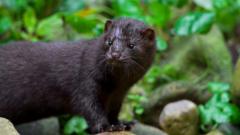
We are witnessing the beginning of the end for the American mink in southern England. For decades, conservationists talked about managing the invasive predator. They talked about controlling numbers. It was a nice, comfortable compromise that ultimately failed. But now, a major initiative aims to slash the mink population in Kent by 90% within just two years.
This isn't about population management anymore. It's a strategic stepping stone toward wiping them out completely.
The Reclaiming Kent’s Waterways project is leading this charge. Backed by a £20,000 grant from the BASC Wildlife Fund, the Waterlife Recovery Trust (WRT) is deploying smart trap technology across the county’s extensive river systems. Kent has historically suffered from one of the highest densities of American mink in Britain. If this project succeeds, it clears the path to make the entire southeast of England—stretching from Kent all the way to Hampshire—entirely mink-free.
The Flaw in Traditional Conservation
For years, local wildlife groups tried to protect native species by trapping mink in small, isolated pockets. It didn't work. The moment a local group stopped trapping, fresh waves of mink simply swam in from neighboring streams and recolonized the area. It was an expensive, exhausting game of ecological whack-a-mole.
What changed? The strategy shifted from localized defense to large-scale, coordinated offense.
The Kent project copies a highly successful blueprint from East Anglia. There, the WRT used a massive network of volunteers and smart traps to achieve a 70% year-on-year reduction in mink numbers. They managed to completely clear mink from a massive 11,000 square kilometer zone covering Norfolk, Suffolk, and East Cambridgeshire.
By scaling the operation up, conservationists are creating large, contiguous safe zones where native wildlife can actually rebuild populations without facing constant slaughter.
Why the Water Vole Can't Wait
The primary target of the mink's voracious appetite is the water vole, immortalized as Ratty in The Wind in the Willows. Today, it holds the grim title of the UK’s fastest-declining mammal. National populations have plummeted by an astonishing 97% since 1950.
Native predators like owls, herons, and otters have always hunted water voles. But voles evolved an effective defense mechanism against them: they dive into the water and duck into their narrow, water-line burrows.
American mink completely break this defense system. They didn't evolve here; they escaped or were freed from fur farms starting in the mid-20th century. Mink are exceptional swimmers, and the females are small enough to squeeze directly into water vole burrows. They don't just take an occasional vole; a single female mink can systematically hunt down and wipe out an entire local colony in days.
Voles aren't the only casualties. Mink are indiscriminate killers. They decimate ground-nesting birds like snipe and lapwing, kill waterfowl, and plunder the nests of kingfishers and sand martins.
Inside the Technology Turning the Tide
The 90% reduction target in Kent relies heavily on a fleet of 56 newly purchased "smart traps" and floating rafts. Old-school trapping required volunteers to physically check every single cage daily to ensure captive animals didn't starve or suffer. It was a massive logistical bottleneck that limited how many traps a project could manage.
Smart traps solve this through automation:
- Electronic Sensors: A digital tag monitors the cage door mechanism.
- Instant Alerts: The moment a door drops, the trap sends an automated text or email alert to a local volunteer.
- Rapid Response: Volunteers only visit traps that have actually triggered, allowing a small team to cover hundreds of square kilometers efficiently.
The project also exploits the mink's biology against it. Traps are baited using a scent lure harvested from the anal glands of previously caught mink. Because mink are intensely territorial, the smell of a "rival" draws them into the traps with incredible efficiency. Once caught, the invasive animals are humanely dispatched.
What Happens Next
The initial phase of the Reclaiming Kent's Waterways project aims to secure 672 square kilometers of the county. WRT organizers report that the public response in Kent has been unprecedented, seeing more volunteer offers and local enthusiasm than any other county so far.
If you live in Kent or manage land near local waterways, you can directly accelerate this recovery.
Contact the Waterlife Recovery Trust to report mink sightings or find out how to host a smart raft on your property. Landowners, farmers, and anglers are proving to be the most vital assets on the ground. If you don't have river access, look into volunteering for local checking networks. Wiping out an invasive apex predator requires a coordinated web of eyes on the ground, and the infrastructure is already active.