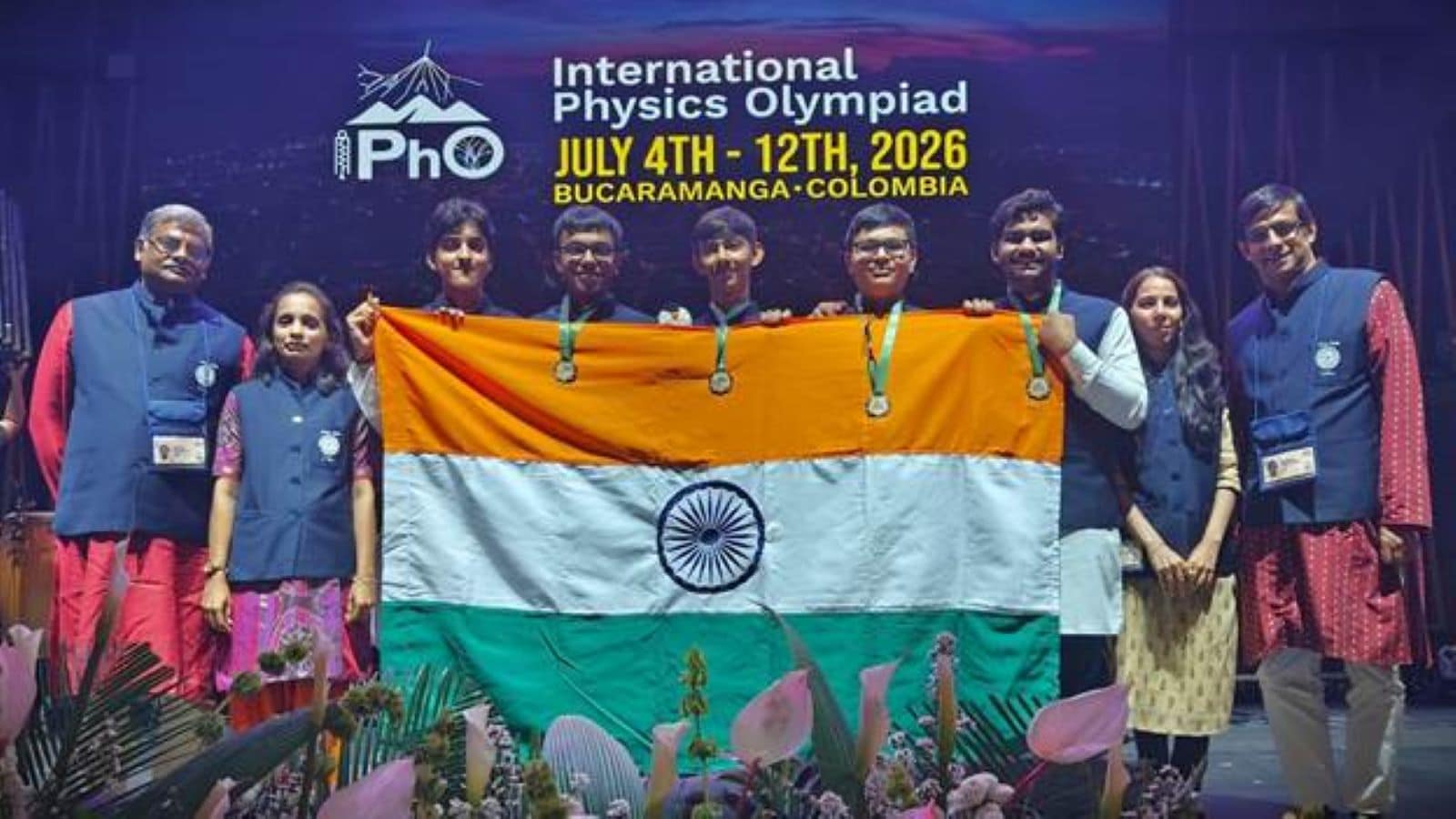
Winning an international competition is always great press. You get the standard congratulatory tweets, a few front-page mentions, and perhaps some handshakes from state officials. But what five teenagers just pulled off at the 56th International Physics Olympiad in Bucaramanga, Colombia, deserves more than passing applause.
India didn't just win medals. They swept the floor.
All five students representing the nation brought home gold. By doing so, India claimed the joint World No. 1 spot alongside heavyweights like China, South Korea, Russia, Kazakhstan, and Taiwan. To put this in perspective, this is only the second time in India's 27-year history at the event that every single team member won gold. The last time this happened was in 2018.
But behind the celebratory headlines lies a story of insane academic pressure, a deeply flawed national education system that these students managed to transcend, and the brutal reality of what it actually takes to master physics at the absolute highest level.
Meet the Five Teens Who Conquered Global Physics
Let's put names to these accomplishments. These aren't just faceless prodigies. They are normal teenagers who happen to possess mind-boggling analytical skills.
- Shresth Suraiya from Mumbai, Maharashtra
- Kanishk Jain from Pune, Maharashtra
- Riddhesh Anant Bendale from Indore, Madhya Pradesh
- Rishit Garg from Dwarka, New Delhi
- Svarit Joshi from Ahmedabad, Gujarat
Over 380 of the brightest minds from 87 countries landed in Colombia. They expected a tough fight. What they got was a masterclass from a highly focused group of Indian students.
These five didn't just scrape by. Several of them came incredibly close to securing perfect scores in the grueling theoretical portion of the exam. According to their mentors, what set them apart wasn't just raw intelligence. It was composure. When you're sitting in an exam room in South America, facing problems that would make graduate students sweat, panic is your biggest enemy. These kids stayed cold as ice.
The Exam Problems That Would Make You Question Your Career Choices
Most people hear "Physics Olympiad" and think of high school textbook problems with slightly harder numbers. That is a massive understatement.
The International Physics Olympiad features two five-hour sessions: one purely theoretical and one experimental. The level of math and physics required is firmly in the upper-undergraduate and early graduate territory. Let's look at what these students actually had to solve during their five-hour theoretical torture test.
Light Inside a Coffee Cup
Have you ever looked at a cup of coffee on a sunny morning and noticed a bright, curved line of light reflecting on the surface? In physics, these are called caustics and cusps.
The students had to mathematically model these light patterns. They calculated how light rays reflect off curved, mirrored surfaces to form concentrated geometric shapes. It sounds simple when you look at your morning brew, but the math behind mapping these envelope curves of reflected rays is incredibly complex.
Paramagnetic Cooling
How do you cool materials down to temperatures incredibly close to absolute zero? You can't just put them in a very good freezer.
The exam required students to calculate the thermodynamics of paramagnetic cooling. This process involves using magnetic fields to align the magnetic moments of a material, dropping its entropy, and then demagnetizing it under insulated conditions to plummet the temperature. This is quantum-level thermodynamics. It requires a deep understanding of entropy, magnetic susceptibility, and thermal properties of materials at extreme scales.
Atmospheric Ozone and Particle Dynamics
If caustics and quantum thermodynamics weren't enough, the test also pushed them into atmospheric and particle physics.
One problem focused on the photoionisation of ozone, requiring students to analyze how high-energy solar radiation breaks down ozone molecules in our atmosphere. Another problem forced them to calculate the high-speed dynamics of electron-positron pairs, bringing relativistic mechanics and electromagnetic field interactions into play.
The Experimental Crucible
Many smart students can memorize formulas and solve theoretical equations. But the experimental exam is where the real separation happens.
In another five-hour session, the students were handed physical apparatuses they had never seen before. They had to investigate thermodynamic processes in fluids and measure heat transfer. The challenge here is that real-world physics is messy. Wires have resistance. Heat leaks into the room. Fluids don't behave like perfect models. The students had to design their own experimental methods, collect highly accurate data, calculate error margins, and draw sound conclusions under a ticking clock.
The Broken Pipeline of Standard Indian Classrooms
There's a massive irony in India's success at these elite competitions.
The standard Indian high school system is notorious for rote learning. Millions of students spend their teenage years memorizing shortcuts to crack multiple-choice questions for competitive engineering exams like the JEE. They learn to solve problems fast, but they rarely learn to think deeply.
In fact, the standard school system actively discourages the kind of curiosity needed to win an Olympiad. In a normal Indian school, a student asking "Why does this formula work this way?" is often told to just memorize it for the exam. Practical labs are mostly a joke, with students copying old experiments from manuals without understanding a single variable.
So how did these five students break out of that mold?
The credit goes to the Homi Bhabha Centre for Science Education (HBCSE), a national center of the Tata Institute of Fundamental Research (TIFR).
HBCSE acts as an oasis in an otherwise dry educational desert. They run the National Olympiad Programme, which is funded and supported by the Department of Atomic Energy. The selection process is a brutal multi-stage filter designed to weed out the memorizers and find the true thinkers.
- Stage 1: NSEP. The National Standard Examination in Physics. Over 30,000 students take this. Only a few hundred survive.
- Stage 2: INPhO. The Indian National Physics Olympiad. This is a descriptive paper that tests deep concept comprehension.
- Stage 3: OCSC. The Orientation-cum-Selection Camp. Around 35 top students are invited to HBCSE in Mumbai for several weeks. Here, they are exposed to advanced college-level labs.
- Stage 4: PDT. Pre-Departure Training. The final five selected students undergo hardcore theoretical and experimental training before flying out.
This program works because it forces students to get their hands dirty. They spend days in labs, learning how to calibrate instruments, account for errors, and think like researchers. It's the polar opposite of the coaching institutes that dominate Indian education.
Why You Should Care About This Success
It's easy to look at this and say, "Cool, five smart kids got medals. How does that affect me?"
It matters because science is the ultimate engine of economic and technological power. The countries that lead the world are the ones that can turn raw scientific talent into real-world technology.
India's historical performance at the physics olympiad is actually stellar. Over their 27 years of participation, about 44% of Indian participants have won gold, 41% have won silver, and 10% have won bronze. In the last decade, every single Indian student sent to the competition has returned with a medal.
This proves that India has the raw intellectual capital to match any country on Earth. The real challenge is retaining this talent.
Historically, many of India's brightest Olympiad winners ended up leaving the country for top US universities like MIT, Stanford, and Caltech, never to return. While that's great for their personal careers, it highlights a critical gap: India needs to build research ecosystems that are attractive enough to keep these elite minds working on home soil.
Fortunately, we are starting to see a shift. Indian research institutes like the Indian Institute of Science (IISc) and the various Indian Institutes of Science Education and Research (IISER) are stepping up their game. They are offering world-class research facilities that can actually compete with Western universities.
Want to Build This Kind of Thinking? Here is the Playbook.
If you are a student, a parent, or simply someone who wants to develop a razor-sharp analytical mind, you can't rely on standard school curriculums. You have to build your own learning path.
Here's the practical playbook based on how these Olympiad champions train.
Throw Away the Multiple-Choice Sheets
Stop practicing to pick an answer from four options. Start solving problems where you have to write down the entire derivation from scratch. If you can't explain every step of your math to a layperson, you don't actually understand the physics.
Dive Into the Classics
Ditch the standard test-prep guides and read books that focus on conceptual beauty.
- The Feynman Lectures on Physics: These lectures don't just teach you formulas; they teach you how to think about the physical universe.
- University Physics by Sears and Zemansky: Excellent for building a rock-solid foundation in mechanics, thermodynamics, and electromagnetism.
- Problems in General Physics by I.E. Irodov: This legendary Russian book is infamous for its difficulty. Don't look at the solutions. Spend hours, or even days, wrestling with a single problem. The struggle is where the brain rewires itself.
Build Things and Break Things
You can't master physics without developing an intuition for the physical world.
Buy basic electronics kits. Play with lenses and lasers. Build a simple pendulum and measure its period, then try to figure out why your real-world measurements don't perfectly match the idealized formula. Learning to troubleshoot physical errors is the most valuable skill you can possess.
Find mentors who challenge you. Seek out communities of like-minded peers who are obsessed with solving hard problems. The Indian team didn't train in isolation; they pushed each other to new heights during their camps at HBCSE. Surround yourself with people who are smarter than you, and never settle for just memorizing the answer.