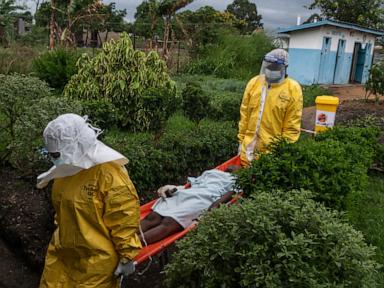
Imagine walking into a hot zone where a deadly virus kills over a third of the people it touches. You don't have enough protective gear. Angry crowds blame you for bringing the disease. To top it off, your bank account is empty because the government hasn't paid you a single cent in months.
That's the brutal reality right now for front-line medical teams fighting the latest Ebola outbreak in the Democratic Republic of the Congo.
Healthcare workers in the epicentre of the crisis are walking off the job. They're striking over missing wages and horrific working conditions. This isn't just a local labor dispute. It's a massive breakdown that threatens to send a dangerous epidemic spiraling completely out of control.
The newest official figures are terrifying. We're looking at 1,708 recorded cases and 580 deaths. The first month of this outbreak has officially clocked in as the worst on record. If the people holding the line refuse to work, those numbers will skyrocket.
Inside the Breakdown in Ituri Province
The crisis is hitting Ituri province the hardest. Ituri sits in the eastern part of the country. It's a region already plagued by deep-seated conflict and insecurity. When the government declared this Ebola outbreak on May 15, local doctors, nurses, contact tracers, and burial teams rushed to help. They expected support. Instead, they got silence.
Front-line workers say they haven't seen their wages or promised hazard bonuses since day one. They issued a 24-hour ultimatum to provincial and national authorities. The deadline passed. Now, the response is crumbling.
Take Dr. Biensi Kano, a specialist on the epidemiological surveillance committee in Ituri's capital, Bunia. He didn't mince words when talking about how the non-payment hits his peers. It exposes families to severe financial ruin. It actively destroys daily living conditions. People can't buy food. They can't pay rent. Yet they're expected to risk their lives every single morning.
On Monday, the frustration boiled over. Workers gathered outside the Rwampara Ebola treatment center. They didn't just stand there with signs. They set tires on fire, blocking roads and sending thick black smoke into the sky. It caused a panic until the police came to clear it out. That's how desperate these professionals have become.
The Broken Money Pipeline
Where's the money? That's the question everyone's asking. Congo's Minister of Health, Roger Kamba, visited the gold-mining town of Mongbwalu recently. Mongbwalu is a raging hot spot for the virus right now. During his visit, Kamba made big promises. He claimed all doctors, nurses, and response teams would be fully supported. He said the government has the funds ready to go.
The people on the ground tell a completely different story. The cash isn't reaching them.
Part of the problem is literal logistics. The airport in Bunia is currently closed. Local health officials admit this shutdown is paralyzing the emergency response. It blocks the physical flow of funds into the province. In a region where digital banking can't be relied upon for large-scale emergency operations, a closed runway means empty pockets.
But structural incompetence plays a part too. Bureaucratic red tape in Kinshasa often stalls emergency funding. Bureaucrats argue over allocations while people bleed out in isolation wards. It's an old story in global health response, and it keeps repeating itself.
Dying for Nothing
The financial strain is only half the nightmare. The physical danger is staggering.
Health workers aren't just fighting a virus. They're fighting fear and deep community distrust. Rumors spread fast in isolated villages. Some people think Ebola is a hoax designed to make Western NGOs rich. Others think the medical teams are injecting people with the virus.
Dr. Ben Bakule works as a community investigator tracking down people who had contact with confirmed cases. In late May, he almost lost his life. An angry mob of young men attacked him and his colleagues in the village of Tutu, located in the volatile Djugu territory. He barely escaped.
Bakule points out that workers are spending their own personal money on transport just to get to dangerous job sites. They thought they'd be rewarded, or at least fairly compensated. Instead, they feel abandoned. He noted that they are taking massive risks and facing the terrifying prospect of dying for absolutely nothing.
When you don't pay your workforce, they stop showing up. When your workforce stops showing up, contact tracing stops. When contact tracing stops, Ebola spreads silently through markets, churches, and crowded gold mines.
The Threat of a New Strain
This specific outbreak involves the Bundibugyo virus strain. It's not the more common Zaire strain that caused the massive West African epidemic years ago or the previous major outbreaks in western Congo. The Bundibugyo strain is less frequent but still highly lethal.
The timing of this strike is particularly disastrous. Scientists were just starting to enroll patients in critical clinical trials for new Bundibugyo treatments. These trials are essential. They help find out what drugs can actually save lives when someone gets infected with this specific variant.
With treatment centers sitting at near-full capacity, a labor walkout completely derails these scientific efforts. Dr. Anne Ancia, the World Health Organization representative in the country, warned that the virus is moving faster than the response. It's being supercharged by constant population displacement and rampant insecurity.
The Domino Effect on Local Communities
The strike doesn't just hurt the sick. It paralyses the local economy.
When an area is declared an Ebola zone, markets slow down. Travel is restricted. Health screenings pop up at every major crossroads. It hits small business owners hard.
Look at Anifa Kito. She runs a small tomato stall in Bunia. She's watching the medical workers strike with absolute dread. She knows that if the response teams give up, the virus will take over the town. She's begging authorities to settle the pay dispute before the entire province collapses into a deeper health disaster.
The workers on strike include the specialized burial teams. This is a critical detail. Traditional funeral practices in Congo involve washing and touching the body of the deceased. But a corpse packed with Ebola is incredibly contagious. Safe, dignified burials conducted by trained teams are one of the most effective ways to break the transmission chain. If those burial teams strike, families will handle the bodies themselves. That means a massive spike in new cases within weeks.
Breaking the Cycle of Failed Outbreak Responses
This mess highlights a massive flaw in how global health crises are managed. Everyone panics when the body count rises. Billion-dollar organizations pledge massive sums of money. International experts fly into capital cities. Yet the actual locals doing the dangerous work are left begging for basic pay.
We need a total shift in how emergency health funds are distributed. If you want to stop an epidemic, you have to protect the people at the bottom of the pyramid.
First, emergency fund allocation must bypass central bureaucratic bottlenecks during a declared crisis. When an outbreak hits, a portion of the international aid needs to go straight into secured, escrowed payroll accounts managed locally or via trusted neutral agencies. Relying on central government structures during a fast-moving crisis is a proven failure.
Second, logistics cannot be an excuse for empty pockets. If the Bunia airport is closed, alternative secure land or helicopter transport routes for essential supplies and operational cash must be established immediately.
Third, the protective gear shortage needs immediate correction. You can't ask a doctor to face the Bundibugyo virus with substandard masks and gloves. It's unethical. It's essentially a suicide mission.
What Needs to Happen Right Now
The government in Kinshasa needs to stop issuing empty press releases. They must get cash into the hands of the Ituri front-line workers within the next 48 hours.
International donors like the World Health Organization and USAID need to step in and directly verify that the funds they provide are reaching the people wearing the hazmat suits. They cannot simply hand over checks to top-tier ministers and assume everything will work out fine.
If you are following global health security, keep your eyes on Ituri. The strike must be resolved immediately. If it drags on, the outbreak will spread past the borders of eastern Congo, and the global community will find itself dealing with a much larger, much more expensive catastrophe.