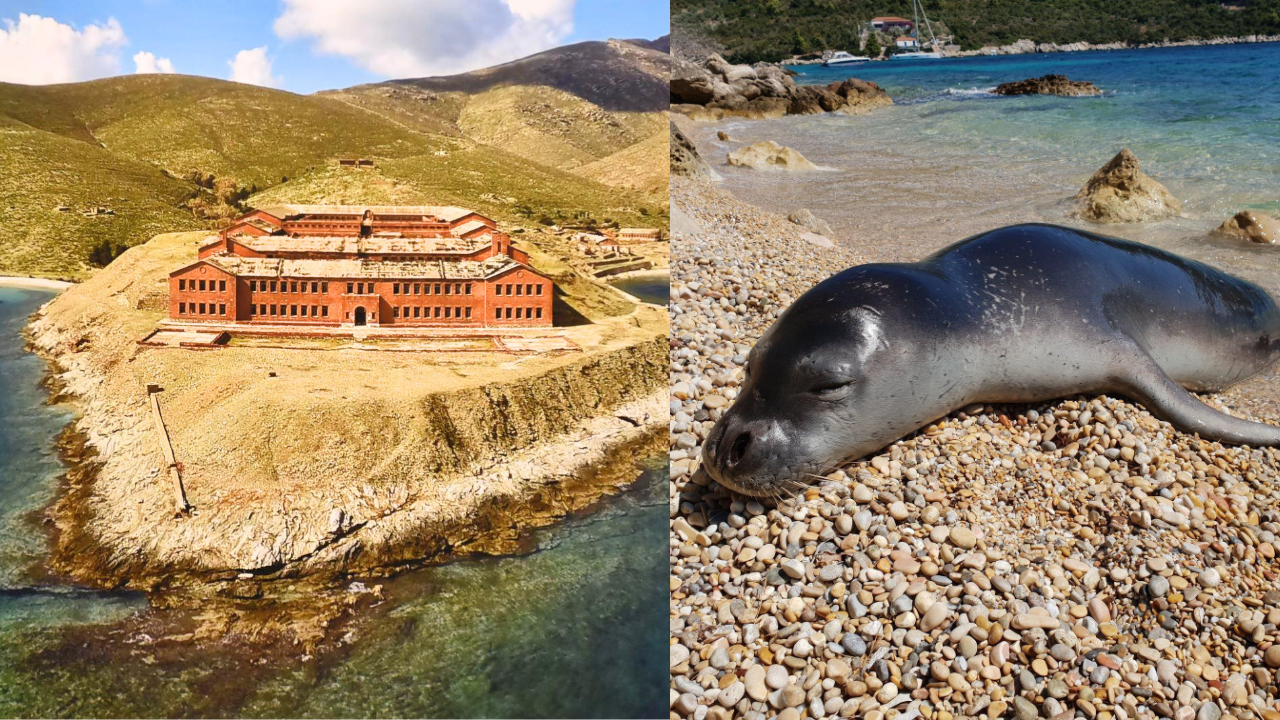
You won't find this island on any standard Aegean cruise itinerary. It sits in the northern Cyclades, a barren hunk of red rock hammered by fierce winds and surrounded by deep, treacherous waters. For decades, mentioning its name caused Greek citizens to shudder. Today, Gyaros island is the center of one of the most intense marine conservation battles in Europe. It holds a secret that completely rewrites what we know about wildlife recovery.
This deserted island hosts the largest breeding colony of Mediterranean monk seals on earth.
That fact is jarring if you know anything about these animals. The Mediterranean monk seal (Monachus monachus) is notoriously shy. Centuries of human hunting, coastal development, and fishing net entanglement drove them away from open beaches. They retreated into pitch-black, underwater marine caves to give birth in secret. Yet, on Gyaros, these highly endangered mammals do something unseen anywhere else. They slide right up onto the open beaches to nurse their pups in broad daylight.
The reasons behind this behavioral shift are deeply tied to a dark history. Understanding how a place of human torture transformed into an ecological fortress tells us exactly what nature can do when humans are forced to step away.
The Brutal History of the Island of Exile
Human presence on Gyaros has historically meant suffering. The Roman Empire used this rocky, waterless wasteland to banish high-ranking political dissidents who fell out of favor with the emperor. The Roman poet Juvenal even wrote about its hostile environment. The true horrors, though, occurred during the 20th century.
Following the Greek Civil War and continuing through the brutal military junta that ruled Greece until 1974, Gyaros became a massive concentration camp. Thousands of political prisoners, communists, and intellectuals were packed into a massive, red-brick prison complex built by the inmates themselves. The conditions were agonizing. Water had to be shipped in. The heat during the summer was suffocating, and winter brought freezing, unchecked gales.
Prisoners faced hard labor and psychological torment. When the prison finally closed after the fall of the dictatorship, the Greek military didn't just abandon the island. They turned it into a naval firing range. For decades, warships blasted the hillsides with live ammunition.
This dark history kept everyone away. No hotels were built. No tourists came to sunbathe. No fishermen could drop their nets near a live bombing zone. This total isolation provided an unexpected shield for the marine life hiding right under the cliffs.
A Shocking Ecological Discovery
In 2008, scientific researchers conducted surveys around the forbidden island. What they found stunned the international scientific community. The coastlines weren't just home to a few stray seals. Gyaros held a massive, thriving colony of Mediterranean monk seals.
With only a few hundred individuals left across their entire global range, finding a concentrated, breeding population changed everything. The seals had found safety in the absolute absence of humans. The heavy naval shelling had stopped in 2002, leaving an untouched marine environment.
Beneath the waves, the ecosystem was spectacularly intact. Massive meadows of Posidonia oceanica seagrass covered the sea floor. These underwater grasses act as vital nurseries for hundreds of fish species. Deeper down, rare coral formations thrived. On the cliffs above, protected seabirds like Eleonora’s falcons and Yelkouan shearwaters nested in peace.
Recognizing this critical habitat, environmental groups pushed for action. In 2011, the island joined the European Natura 2000 network. By 2019, Greece declared Gyaros the very first Marine Protected Area in the Cyclades.
The 2022 Crisis and the Tragedy of the Commons
Protecting an island on paper is easy. Enforcing that protection in the middle of the Aegean Sea is a completely different story.
For a long time, the island functioned effectively as a strict no-take zone because the Greek state failed to set up a proper licensing system for local fishermen. This accidental total protection allowed fish stocks to explode. Seeing the massive abundance of fish, local commercial fishing associations put intense political pressure on the government.
In June 2022, the Ministry of Environment cracked under that pressure. They opened up the protected waters to small-scale fishers without requiring special permits or reporting.
What followed was a devastating example of the tragedy of the commons. A chaotic, unregulated race for fish began. Dozens of boats descended on the sanctuary, dropping miles of nets right over the delicate reefs and seagrass beds. Within weeks, scientists monitoring the area witnessed a rapid, terrifying decline in fish populations and heavy damage to the marine habitats.
The scientific community and national media raised a massive public outcry. The thought of losing this hard-won sanctuary sparked outrage across Greece. By September 2022, the government reversed its decision, completely banning all fishing around Gyaros once again. This volatile event proved that even a thriving sanctuary can be ruined in a matter of months without permanent legal shields.
Permanent Protection Secured in 2026
Lessons from that near-disaster paved the way for a massive legal victory. On April 16, 2026, the President of Greece officially signed a long-awaited Presidential Decree for Gyaros.
This decree completely changes the game for the island's future. It replaces temporary, shifting ministerial decisions with a permanent, legally binding framework that cannot be easily stripped away by seasonal political winds. The new law officially establishes rigid protection zones and permanent management rules. Authority now sits squarely with the Coast Guard and the Natural Environment and Climate Change Agency.
To keep illegal fishers out, conservationists built an incredible surveillance system. WWF Greece installed a network of long-range marine radar, high-definition thermal infrared cameras, and autonomous drones. This system scans the blacked-out waters of the Aegean for miles around the island. If a poaching vessel attempts to slip into the protected zone at 2:00 AM, the thermal cameras instantly flag the boat, alerting the Coast Guard station on the nearby island of Syros.
The European Commission recognized this tech-driven defense network as a model best practice for environmental protection across the entire European continent.
How You Can Engage with Gyaros Responsibly
You cannot simply rent a boat in Mykonos or Santorini and sail over to Gyaros for a day trip. The island remains completely uninhabited, and unauthorized human access to its coastline is strictly prohibited to keep from scaring the seals. If you want to support this historic conservation win, you have to do it through specific, authorized channels.
Support the Organizations on the Front Lines
The survival of these seals relies heavily on continuous field research and hardware maintenance. Consider backing the groups doing the daily work.
- MOm: The Hellenic Society for the Study and Protection of the Monk Seal handles real-time biological monitoring, pup rehabilitation, and cave tracking.
- WWF Greece: This team spearheaded the 13-year campaign that culminated in the 2026 Presidential Decree.
Visit the Authorized Exhibits in Syros
The historic port of Ermoupoli on the neighboring island of Syros houses educational displays, interactive maps, and historical archives detailing the dual history of Gyaros. It lets you view the architectural remains of the prison camp and learn about the marine ecosystem without disturbing a single seal pup.
Choose Eco-Conscious Dive and Boat Operators
When traveling through the Cyclades, only book excursions with maritime operators who explicitly state compliance with regional Marine Protected Area guidelines. If an independent skipper offers to take you illegally close to the Gyaros coastline, refuse the trip and report the operator to the local Hellenic Coast Guard unit. True preservation means keeping human feet off these fragile beaches.