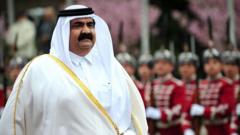
The man who single-handedly turned a bankrupt desert peninsula into the world's most aggressive economic powerhouse is gone. Qatar’s Amiri Diwan announced that former Emir Sheikh Hamad bin Khalifa Al Thani died on Sunday morning at the age of 74. The country immediately entered a four-day period of national mourning, shutting down government offices and lowering flags to half-mast.
If you think this is just standard state news about a retired Middle Eastern monarch, you're missing the entire story.
When Sheikh Hamad seized power from his own father in a bloodless palace coup back in 1995, Qatar was struggling to pay its bills. Its oil reserves were running dry. By the time he voluntarily stepped down in 2013, he had built a nation so rich and politically relevant that global superpowers had no choice but to listen to it. He didn't just rule Qatar; he invented modern Qatar.
The Billion Dollar Liquefied Natural Gas Gamble
Most rulers play it safe. Sheikh Hamad did the exact opposite. When he took over at age 44, he inherited a country wedged uncomfortably between two regional giants, Saudi Arabia and Iran. He knew that small countries without economic leverage get swallowed up or ignored.
His solution was to bet the entire nation’s future on liquefied natural gas (LNG).
At the time, exploiting the massive North Field gas reserve was considered an insane financial risk. It required borrowing billions of dollars to build highly complex, unproven liquefaction infrastructure. Western analysts doubted it would pay off. Sheikh Hamad ignored them, brought in international energy partners, and built the supply chains anyway.
The gamble changed global energy markets forever. Qatar quickly became one of the world's largest exporters of LNG. The revenue didn't just fill the state coffers; it created a sovereign wealth fund, the Qatar Investment Authority, that started buying up the world.
Think about it. If you've ever shopped at Harrods in London, watched a Paris Saint-Germain football match, or looked at the London skyline dominated by the Shard, you're looking at the financial legacy of Sheikh Hamad. He realized early on that international investments were the ultimate defense strategy for a tiny state.
The Maverick Foreign Policy That Irritated Everyone
Sheikh Hamad refused to let Qatar be a quiet junior partner in Gulf politics. He wanted influence, and he bought it through soft power and incredibly bold diplomacy.
In 1996, he funded the launch of Al Jazeera. The satellite network completely disrupted the state-controlled media environment of the Arab world. It gave a voice to dissidents, covered regional protests, and infuriated neighboring monarchs and dictators alike.
Sheikh Hamad's Rule (1995 - 2013)
├── Economic: Shifted focus from oil to LNG, creating massive sovereign wealth.
├── Media: Funded and launched Al Jazeera in 1996.
├── Diplomacy: Positioned Qatar as a regional mediator while hosting US Central Command.
└── Sports: Secured the controversial and historic 2022 FIFA World Cup bid.
He ran a foreign policy that looked completely contradictory on paper but worked brilliantly in practice. He hosted the US Central Command at Al Udeid Air Base, giving Washington its most critical military hub in the region. At the same exact time, he maintained open diplomatic lines with Iran, Hamas, and various Islamist factions.
He positioned Qatar as the ultimate middleman. If the world needed to negotiate a hostage release, broker a truce in Yemen, or talk to the Taliban, they had to call Doha.
This maverick style didn't come without a cost. His support for popular uprisings during the Arab Spring and his alignment with groups like the Muslim Brotherhood deeply angered Saudi Arabia and the United Arab Emirates. The geopolitical fault lines he created during his 18-year rule eventually triggered the massive diplomatic blockade of Qatar years later. He didn't care about making friends with neighboring royals; he cared about making Qatar indispensable.
Breaking Tradition Until the Very End
In the Gulf, rulers generally leave office in a coffin or via a coup. Sheikh Hamad broke that rule too.
In June 2013, he voluntarily abdicated, handing the throne to his fourth son, Sheikh Tamim bin Hamad Al Thani. He was only 61 at the time and in relatively good health. He explained that it was time for a new generation with new energy to lead the country. It was a calculated, brilliant political move designed to ensure a seamless transition of power and prevent the messy internal family squabbles that usually plague hereditary monarchies.
Even in retirement, his presence loomed large as the "Father Emir." His wife, Sheikha Moza bint Nasser, continued to drive massive domestic investments in education and global cultural footprints through the Qatar Foundation.
The funeral prayers are scheduled at the Imam Muhammad ibn Abd al-Wahhab Mosque in Doha, with burial at the Lusail Cemetery. Leaders from across the Middle East and the world are already sending condolences. It's a reflection of just how far the tiny state climbed under his watch. He leaves behind a nation that sits on top of the world's financial hierarchy, holding immense leverage over global energy and politics.
If you want to understand why a tiny peninsula in the Gulf wields so much power today, stop looking at current headlines. Look at the high-stakes decisions Sheikh Hamad made three decades ago.
Go read up on the history of the North Field gas project to understand how real economic leverage is built from scratch.