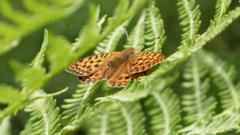
Britain’s most endangered butterfly is not dying out because of a lack of green spaces. It is dying out because our fields have become too neat.
The high brown fritillary was once a common sight across English and Welsh woodlands, but decades of industrial farming and well-meaning but misguided land preservation have pushed it to the absolute brink. Today, it clings to survival in just four isolated regions: Dartmoor, Exmoor, the Glamorgan Brackenlands, and the limestone hills around Morecambe Bay.
If you want to save this insect, you do not look to high-tech laboratories or pristine nature reserves where humans banish all disturbance. You look to a herd of mud-covered, heavy-footed native cattle.
Conservationists are deploying cows as heavy machinery to rescue the high brown fritillary. It sounds contradictory. Butterflies are fragile things; cattle are walking tanks. Yet without the deep trampling and messy grazing habits of these animals, the specific micro-habitats this butterfly requires completely vanish.
The Fussy Ecology of an Endangered Icon
To understand why a 600-kilogram cow matters to a two-inch butterfly, you have to look at the absurdly specific lifecycle of the high brown fritillary. This is not a generalist insect that can lay its eggs on any backyard weed. It relies almost exclusively on the common dog-violet.
But having violets around is only half the battle. The butterfly needs those violets to grow in a very specific environment.
In the cool, damp British climate, wild violets often grow under a canopy of bracken. During the winter, this bracken dies back, creating a thick layer of dead, brown fronds on the ground. When the female high brown fritillary searches for a place to deposit her eggs in high summer, she doesn't drop them on the green leaves. She crawls along the floor, sometimes for minutes at a time, tucked away from predators, hunting for the perfect patch of dead bracken litter right next to a violet plant.
This dead bracken acts as a natural incubator. In early spring, when the sun hits these dry, brown mats, they trap heat. The ground temperature within a layer of bracken litter can be a staggering 15 to 20 degrees Celsius warmer than the surrounding open grassland.
This extreme microclimate is exactly what the overwintered eggs need to hatch. The emerging caterpillars require that intense heat to develop rapidly before pupating into adults by mid-June. If the ground is too cold, the caterpillars grow too slowly, succumb to damp conditions, or get picked off by predators.
The Goldilocks Dilemma of Bracken Mattresses
This is where the environment becomes incredibly fragile. The high brown fritillary requires a perfect balance.
If there is too little bracken, the ground lacks the insulating mattress needed to keep the larvae warm. The eggs freeze or fail to hatch.
If there is too much bracken, the plants grow into a dense, suffocating monoculture. The thick canopy blocks out the sunlight entirely, preventing the common dog-violet from growing at all. Even worse, the dead fronds pile up year after year into an impenetrable wall of thatch. The adult butterflies cannot fly through it to lay eggs, and the caterpillars cannot navigate the dark, freezing ground beneath it.
For centuries, this balance was maintained naturally. Traditional British countryside management involved mixed livestock grazing and regular cutting of bracken for animal bedding. After the Second World War, agriculture shifted. Farmers abandoned marginal hillsides, stopped harvesting bracken, and swapped native cattle for sheep.
The results were catastrophic for the butterfly. Left unchecked, bracken took over entire hillsides, turning varied hillsides into sterile, choked wildernesses. Between 1976 and the mid-2010s, the UK population of the high brown fritillary plummeted by over 60 percent. By 2015, entomologists officially labeled it the single most threatened butterfly in Britain.
Why Sheep Fail and Cows Succeed
When land managers noticed the decline, the initial reaction was often to turn out sheep to graze the hillsides. It was a massive mistake.
Sheep are delicate, selective nibblers. They act like furry lawnmowers, eating the sweetest grasses right down to the root, turning diverse hillsides into uniform, short turf resembling a golf course. They completely avoid dense bracken because it is toxic to them. Worse, sheep grazing creates a cool, flat ground surface that eliminates the warm microclimates the caterpillars desperately need.
Cows operate completely differently.
"Cattle do not just eat; they destroy. And that destruction is exactly what a choked habitat needs."
A native breed of cow—like a Red Poll, a Shorthorn, or a Highland—does not bite grass cleanly. It wraps its tongue around large clumps of vegetation and tears them out by the roots. This creates a highly irregular, varied structure in the turf. They push through dense stands of bracken that sheep would never dare enter.
More importantly, cattle possess immense weight. As they trample through thickets of bracken, their hooves smash through the dead, matted fronds on the ground. They crush the suffocating thatch, breaking it up into patchy mosaics.
This mechanical trampling achieves three vital conservation goals simultaneously:
- It creates open, sunlit pathways through the bracken that adult butterflies use as flight corridors.
- It exposes the soil just enough for common dog-violets to germinate and thrive without being choked out.
- It presses chunks of dead bracken into the dirt, creating localized, hyper-warmed pockets of litter where females can lay eggs.
Data from recent long-term ecological monitoring projects backed this up clearly. A study tracking butterfly populations across upland calcareous grasslands demonstrated that fields lightly grazed by native cattle had nearly five times the abundance of butterflies compared to fields grazed by sheep. Even entirely ungrazed, abandoned plots outperformed sheep-grazed land by more than three to one. The message is undeniable: intense sheep grazing strips away the structural complexity that keeps rare insects alive.
The Reality of Running an Animal Workforce
Using cattle as conservation tools sounds simple on paper, but executing it in the modern British countryside is a logistical nightmare. It requires a completely different approach to herd management.
Traditional commercial farming values uniform weight gain and high stocking densities. Conservation grazing requires the exact opposite. The ideal setup involves incredibly low stocking rates—often around 0.2 livestock units per hectare per year. The cattle are not meant to eat everything in sight; they are meant to wander randomly, leaving patches of long grass next to trampled bracken and short-bitten turf.
Finding farmers willing to manage cattle this way is tough. Native breeds grow slower and yield less meat than modern continental breeds, making them less profitable in a standard market.
Then comes the physical environment. The steep, rocky slopes of Dartmoor or the limestone pavements of Morecambe Bay are brutal on livestock. Animals can fall, get trapped, or wander onto increasingly busy rural roads.
In some areas, like the Gower Commons in Wales, local communities have tried to bypass these issues by forming cooperative herds. One project, known locally as Cowtan, saw neighbors club together to purchase and manage a shared herd specifically to graze down invasive purple moor grass and break up choking bracken. The initiative helped bring back plants like the devil's-bit scabious and the common dog-violet, providing a lifeline for both the marsh fritillary and the high brown fritillary.
Yet, serious structural barriers remain. Herds grazing on open commons face a high risk of bovine tuberculosis (TB), which triggers mandatory, expensive testing every six months. For a small-scale grazier or a conservation charity, the financial and emotional toll of a TB breakdown can end a project overnight. Right now, there is very little direct financial compensation from agricultural policy that rewards farmers for the specific ecosystem benefits their cows provide through trampling and selective disturbance.
The 2024 Emergency and the Volunteer Fightback
The urgency of this work became painfully clear following recent weather extremes. The charity Butterfly Conservation declared a nationwide butterfly emergency after data from their annual monitoring schemes showed numbers hitting historic lows.
The high brown fritillary is incredibly sensitive to volatile weather sequences. A hot, dry spring followed by an unseasonably cold, wet summer can wipe out half of a breeding population in a single season. Because the remaining colonies are so heavily fragmented and isolated from one another, a localized weather disaster can completely extinguish a colony with zero chance of natural recolonization from neighboring hillsides.
Because we cannot control the weather, managing the habitat to maximum efficiency is our only lever.
Where cows cannot go, humans are stepping in to mimic them. In valleys across Exmoor and Dartmoor, teams of volunteers, rangers, and contractors actively march into the thickets during winter. Armed with tools or simply wearing heavy boots, they manually smash down paths through the bracken, copying the trampling action of a wintering herd.
It works remarkably fast. Rangers have noted that within minutes of clearing a path through a dense bracken canopy on a sunny July afternoon, adult high brown fritillaries will drop down into the newly created clearing to bask or look for egg-laying sites.
Practical Action: How to Help on the Ground
Saving a species as specialized as the high brown fritillary requires coordinated landscape-scale management, but individual choices still dictate the broader survival of British pollinators.
If you own or manage larger acreage or marginal hillside land, consider the following structural shifts:
- Phase out uniform sheep grazing: Replace heavy sheep stocking with low-intensity, rotational grazing using hardy native cattle breeds like Galloway, Highland, or Shorthorn.
- Manage bracken as a mosaic: Do not attempt to eradicate bracken entirely with chemical sprays. Instead, use rolling or cutting techniques to break up dense stands, aiming for a patchy mix of light bracken cover and open grassy glades.
- Encourage winter disturbance: Allow livestock to remain on bracken slopes into the late autumn or early winter. Their hooves will help break up the dead canopy before the spring growing season begins.
For individuals without agricultural land, the focus shifts to citizen science and localized habitat support:
- Participate in structured monitoring: Join the UK Butterfly Monitoring Scheme or take part in localized timed counts organized by the Butterfly Conservation local branches. Accurate population data tells conservationists exactly which grazing regimes are working.
- Cultivate wild corridors: If you live near any of the four remaining strongholds, establish native violet patches in your garden borders. While high brown fritillaries rarely breed in small gardens, these spots offer vital nectar stepping stones for dispersing adults looking for new territories.
- Advocate for grazing policy shifts: Support local conservation trusts that partner with tenant farmers. Lobby for agricultural subsidy frameworks that financially reward livestock graziers based on habitat structural diversity rather than raw meat production.
The high brown fritillary does not need a untouched, pristine wilderness. It needs an chaotic, working countryside where livestock are allowed to make a mess. If we keep treating our hillsides like manicured parks, we will lose one of our finest native insects forever.