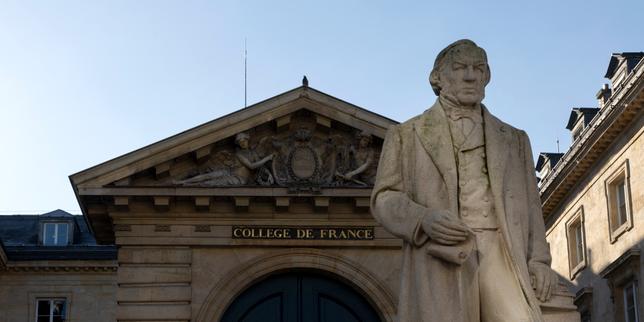
The Paris Administrative Court just delivered a massive reality check to institutional cowardice. On July 15, 2026, the court ruled that the Collège de France acted illegally when it abruptly canceled a high-profile scientific colloquium on Palestine back in November 2025.
For months, university administrators across France have used "security concerns" and "institutional neutrality" as convenient shields to shut down difficult conversations. This ruling shatters that defense. The court didn't just rap the prestigious institution on the knuckles; it drew a hard, permanent line in the sand for academic freedom in France. For another perspective, consider: this related article.
If you want to understand why this decision matters so much for the future of free speech in higher education, we need to look at what actually went down behind closed doors, how a government minister overstepped his bounds, and what this legal precedent means for research institutions going forward.
The Backstory of an Academic Shutdown
Let’s refresh our memory on what happened in late 2025. The event wasn't some fly-by-night political rally. It was a rigorous two-day academic conference titled "Palestine and Europe: The Weight of the Past and Contemporary Dynamics". It was fully planned, fully scheduled for November 13 and 14, 2025, and organized by Henry Laurens—one of the most respected historians of the contemporary Arab world. Related analysis on this matter has been published by USA Today.
The guest list featured serious geopolitical heavyweights: former EU foreign policy chief Josep Borrell, former French Prime Minister Dominique de Villepin, and UN Special Rapporteur Francesca Albanese.
Then the political machinery started grinding. Right-leaning media outlets like Le Point ran critical pieces. Advocacy groups like the International League Against Racism and Anti-Semitism (LICRA) started shouting, calling the event an "anti-Zionist circus". Instead of standing firm, the administrator of the Collège de France, Thomas Römer, panicked. On November 9, just days before the first panel was set to begin, he pulled the plug.
The official excuse? The institution claimed it had to protect the "safety of property and people" and maintain "strict neutrality".
Honestly, it was a terrible look. It looked even worse when the Minister of Higher Education, Philippe Baptiste, publicly patted Römer on the back, calling the cancellation "responsible". Academics smelled blood in the water. More than 2,500 researchers and students signed a petition demanding the minister’s resignation, calling the move a direct assault on scientific liberty.
Why the Initial Legal Battle Failed
When the organizers tried to fight the cancellation in November 2025, they lost the first round. But context matters here. That initial defeat wasn't because the court thought the cancellation was right. It was a procedural quirk.
The organizers filed an emergency petition known as a référé-liberté. In French administrative law, a référé-liberté requires the judge to act within 48 hours, but it carries an incredibly high bar: the plaintiff must prove an imminent, irreversible violation of a fundamental freedom that cannot be resolved any other way.
Because the co-organizer, the Arab Center for Research and Political Studies (CAREP), managed to scramble at the last minute and host the conference in their own cramped offices in the 13th arrondissement, the emergency judge threw out the case. The judge basically said, "Look, you found another room, and you're livestreaming it online, so there's no urgent emergency requiring me to overturn the administrator's decision today".
The conference went ahead in that cramped space. Online viewership cleared 30,000 streams—massive numbers for a dry academic panel. But the prestige of the Collège de France had been denied to the speakers, and the pavement outside CAREP was defaced with aggressive graffiti. The damage was done.
The Merits Judgement That Changed Everything
Fast forward to July 2026. The emergency dust had settled, but the lawsuit on the merits (au fond) kept moving through the system. This is where the Paris Administrative Court looked at the actual substance of the decision, free from the ticking clock of a 48-hour emergency window.
The court's ruling is devastating for the Collège de France administration.
The judges tore down the "security threat" argument entirely. For an public institution to cancel a scheduled event based on security, the threat must be real, documented, and entirely unmanageable by local law enforcement. You can’t just point to a couple of angry tweets or an op-ed you didn't like and claim the building is going to be burned down. The court made it clear that the administrator failed to demonstrate any legitimate, unmanageable risk to public order.
Then came the neutrality argument. The court reminded the Collège de France that institutional neutrality doesn't mean hiding from controversial topics. In fact, it means the exact opposite. True neutrality requires an institution to protect the space for academic debate, even when—and especially when—the topic is highly polarized. By canceling the conference to avoid political noise, the administration didn't protect neutrality; they surrendered to political pressure.
The Dangerous Myth of "Safe" Academic Spaces
This ruling exposes a growing, toxic trend in European academia. Administrators are terrified of controversy. They confuse their job—which is running the logistics of a university—with being arbiters of acceptable thought.
When a university cancels a panel on Palestine, or immigration, or climate policy because they’re afraid of a protest, they invite more pressure. They tell activist groups that if you threaten enough noise, the administration will fold. It's a heckler’s veto, plain and simple.
The court saw right through it. The judges explicitly stated that the Collège de France committed an abuse of power. The minister's intervention was also viewed by the academic community as an unprecedented overreach of state authority into independent research.
What makes this case so critical is that it sets a binding precedent. The next time a university president thinks about canceling a controversial symposium to keep their week peaceful, they have to factor in the legal reality that they will likely be taken to court and lose.
Practical Next Steps for Academic Insiders
This ruling isn't just a moral victory; it's a tool. If you're a researcher, student organizer, or faculty member facing institutional pushback for controversial programming, here is how you use this precedent to protect your work:
- Document the Security Assessments: If an administrator hints at canceling your event due to "safety concerns," formally request the written police or internal security reports backing up that claim. Under the framework validated by the July 2026 ruling, vague anxieties don't hold legal water.
- Challenge the Neutrality Trap: Remind your department heads that institutional neutrality means maintaining an open forum, not sanitizing the schedule. Cite the Paris Administrative Court’s distinction between ideological bias and legitimate scientific inquiry led by established chairs.
- Coordinate with Co-Organizers Early: Keep your alternative logistics tight but don't let a backup venue stop you from pursuing a full legal review on the merits if your primary institutional access is revoked. The long-term legal precedent is worth the fight.
The era of using administrative chicken-outs to censor legal, peaceful academic speech is officially hit with a roadblock. The Collège de France chose institutional comfort over scientific courage, and the courts just made them pay the price for it.