Building a massive, nuclear-powered aircraft carrier is a flashy way to flex military muscle. Everyone looks at the flight deck, the stealth fighters, and the electromagnetic catapults. But if you talk to actual naval strategists, they will tell you that a carrier is only as good as the ship feeding it. Without a constant stream of jet fuel, bombs, and food, a multi-billion-dollar supercarrier is just a floating target waiting to run out of juice.
That is exactly why the latest satellite imagery from southern China matters so much.
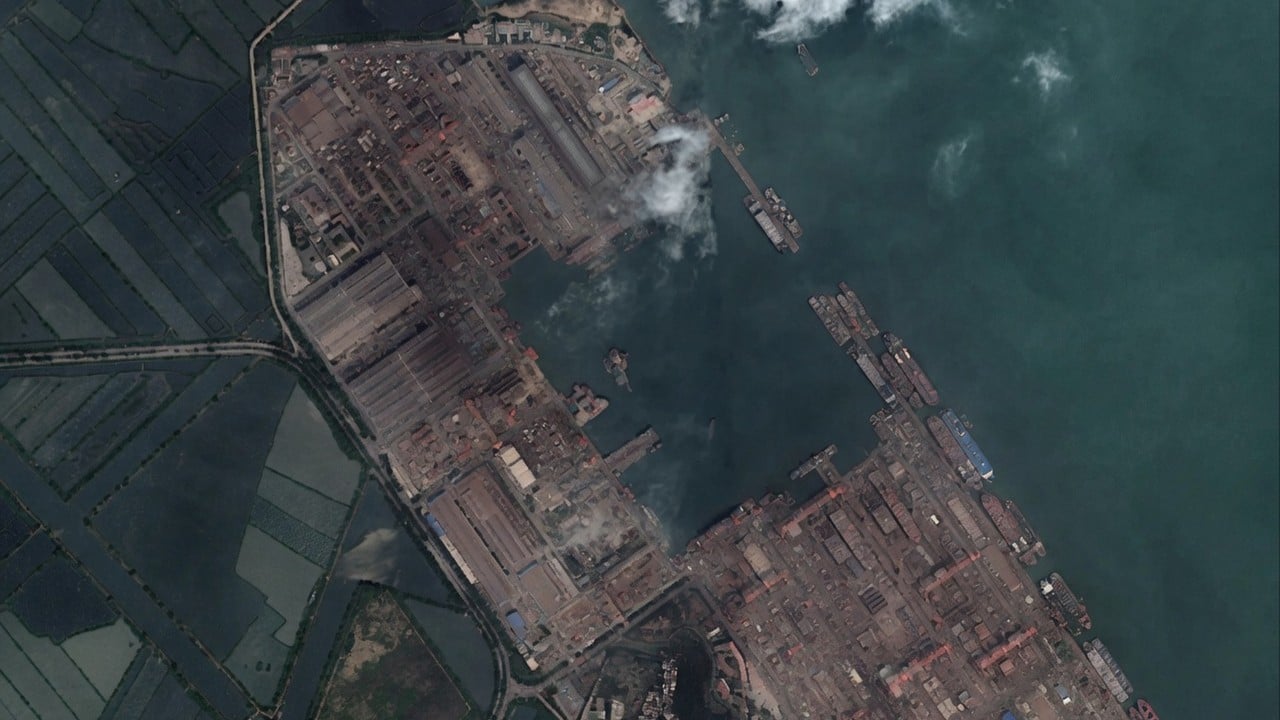
Recent snapshots from Guangzhou Shipyard International on Longxue Island show China is quietly building a truly monstrous naval replenishment ship. Early estimates suggest this thing is roughly 270 meters long and 37 meters wide. It could easily displace over 60,000 tons when fully loaded.
To put that in perspective, it is significantly larger than China’s current Type 901 fast combat support ships. It even dwarfs the US Navy’s biggest Supply-class logistics vessels.
This is not just a routine construction update. It is the missing piece of China's plan to project serious naval power far away from its own shores. The People's Liberation Army Navy is building a massive support ship because its upcoming Type 004 nuclear supercarrier absolutely demands it.
The Boring Truth About Blue Water Operations
Amateurs study tactics while professionals study logistics. It is an old military cliché because it is true.
Right now, China has three active aircraft carriers: the Liaoning, the Shandong, and the recently commissioned Fujian. The first two are smaller, oil-burning ships with ski-jump ramps. The Fujian is a massive step forward, using electromagnetic catapults similar to American supercarriers. But all three of these ships share a common limitation. They are bound to East Asia. They rely heavily on land-based supply lines and nearby ports.
When a carrier strike group sails out into deep water, it burns through supplies at an alarming rate. Think about thousands of sailors eating three meals a day. Think about destroyers burning fuel to keep up with the carrier. Most importantly, think about a wing of J-35 and J-15T fighter jets flying multiple sorties a day. They consume thousands of gallons of aviation kerosene every hour. They drop heavy precision ordnance that needs constant replacement.
China currently relies on two Type 901 fast combat support ships—the Hulunhu and the Chaganhu—to handle high-speed replenishment at sea. These 45,000-ton vessels are impressive. They can run at 25 knots to keep pace with a fast-moving combat fleet. But as China pushes further into the Indian Ocean and the wider Pacific, two ships simply cannot keep up with a growing fleet of massive carriers.
Sizing Up the New Logistics Giant
The new vessel taking shape in Guangzhou is designed to break through those operational limits. It represents a massive scale increase over anything the Chinese navy has built before.
Looking at the structural layout from the open-source images, the design follows a twin-superstructure configuration. You have a large bridge and mast structure near the bow, and a separate housing area for the exhaust stacks near the stern. This layout mimics the successful Type 901 design but stretches the dimensions significantly.
What do you get when you stretch a supply ship to 270 meters long and 37 meters wide? You get an incredible amount of internal volume.
This extra space translates directly to endurance. A 60,000-ton hull allows for massive internal liquid fuel tanks. It means deep, heavily protected magazines for anti-ship missiles, surface-to-air missiles, and smart bombs. It also means larger cold-storage areas for provisions and tons of spare parts for high-tech weapon systems.
The ship will feature multiple midship replenishment gantries. These heavy frames allow the supply ship to transfer liquids and solids to two warships simultaneously while sailing side-by-side at high speed. It is a dangerous, highly coordinated dance that requires specialized automated winches and tension-leg systems to keep cables from snapping in heavy seas.
The Direct Link to the Type 004 Supercarrier
You cannot separate the birth of this giant supply ship from what is happening further north at the Dalian Shipyard. That is where China is currently assembling the Type 004, its fourth aircraft carrier.
The Type 004 is widely expected to be a nuclear-powered supercarrier displacing between 110,000 and 120,000 tons. It will carry an air wing of over 90 aircraft, including stealth fighters, fixed-wing airborne early warning planes, and advanced drones.
People often think a nuclear-powered carrier can stay at sea forever because it does not need fuel oil for its own engines. That is a misconception. The ship itself does not need oil, but its airplanes definitely do. A nuclear supercarrier actually burns through aviation fuel faster than a conventional carrier because it can launch more airplanes, more frequently, over longer periods.
A 120,000-ton supercarrier needs an equally scaled-up support system. A standard supply ship would be emptied out after just a few days of intense flight operations. By pairing the Type 004 with a 60,000-ton replenishment ship, China ensures that its premier strike group can operate in deep water for months at a time without needing to dock at a friendly port.
Escaping the First Island Chain
There is a major geographic hurdle driving this entire naval buildup. China feels trapped behind the First Island Chain, a string of islands running from Japan down through Taiwan and the Philippines. In a conflict, US-aligned forces could easily choke off the narrow straits leading out into the open ocean.
To counter this, China wants a fleet that can operate well beyond those chokepoints. They want to project power into the Second Island Chain and secure the sea lines of communication across the Indian Ocean, where most of China's oil imports travel.
Sustaining a carrier group thousands of miles away from home requires a massive logistical footprint. The US Navy solves this with a global network of bases in places like Guam, Japan, and Singapore, backed by a massive Military Sealift Command fleet. China does not have that luxury. Outside of a modest base in Djibouti, they lack major overseas naval installations capable of refitting a carrier strike group.
This new super-supply ship acts as a mobile base. It gives the Chinese navy the freedom to ignore geographic constraints and operate wherever it wants, independent of foreign ports.
What Comes Next for Chinese Naval Power
Do not expect this new logistics vessel to show up on the front lines tomorrow. Building the hull is just the first step.
The ship will need to undergo extensive sea trials to test its propulsion systems and hull stability. More importantly, the crew will need to spend months practicing underway replenishment with China's newest destroyers and carriers. Transferring tons of explosives and volatile jet fuel across open water while moving at 20 knots is incredibly difficult. It takes years of institutional practice to get right without causing a catastrophe.
If you want to track where the Chinese navy is actually heading, stop focusing entirely on the carriers. Keep your eyes on the supply ships. The moment this new 60,000-ton behemoth hits the water and begins training, you will know that China's blue-water ambitions have officially shifted from a regional aspiration to a global reality.
For a closer look at China's expanding naval capabilities and how its shipbuilding pace compares to other global powers, check out this detailed breakdown of the USS Gerald R. Ford vs China's new carrier technology. This video provides helpful visual context regarding the massive scale of these modern supercarriers and the immense logistical effort required to protect and sustain them at sea.
http://googleusercontent.com/youtube_content/1
/cdn.vox-cdn.com/uploads/chorus_image/image/73064899/1255687.0.jpg)