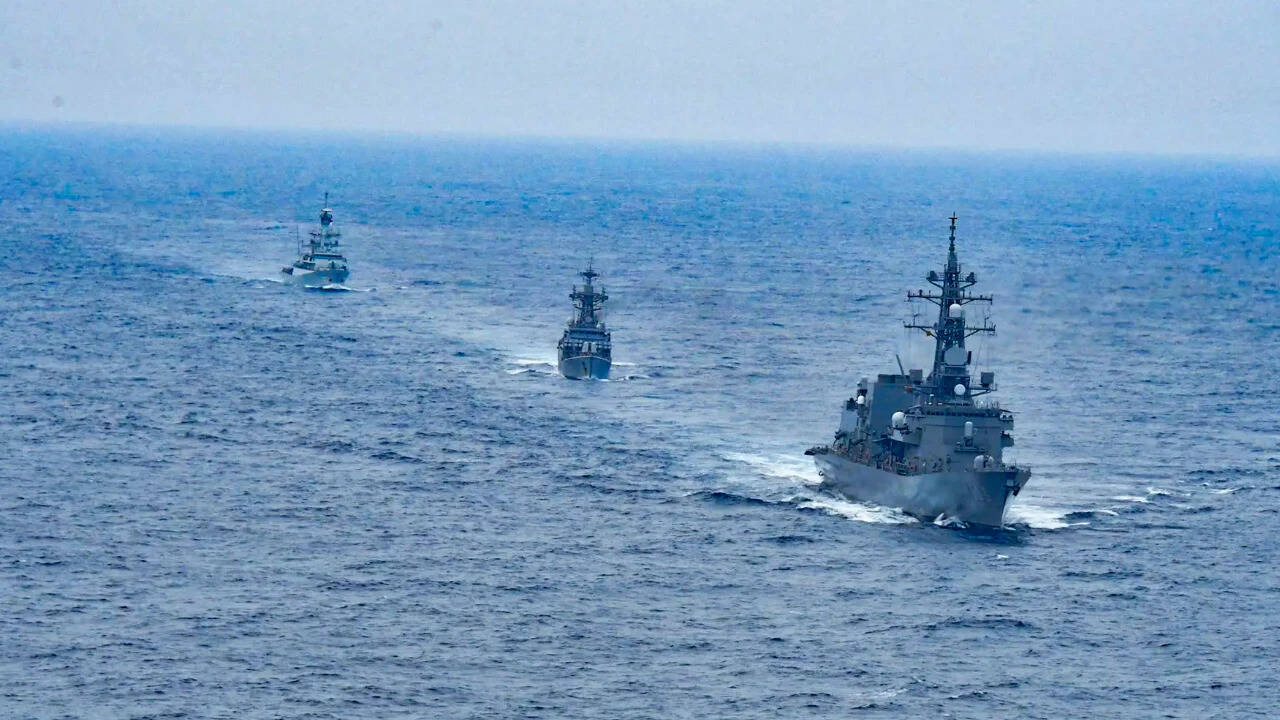
Beijing has a new obsession, and it isn't just the United States Navy. If you watch the rhetorical fire coming out of China's foreign ministry and state-backed think tanks lately, the real target of their fury is Tokyo.
When a prominent Chinese maritime intellectual claims that Japan's military role in South China Sea activities is turning out to be more destructive than American intervention, you need to pay attention. This isn't just standard diplomatic posturing. It marks a profound shift in how Beijing views the balance of power in Asia. For decades, China relied on Japan's pacifist constitution to keep Tokyo out of its southern maritime backyard. That era is officially dead.
The Real Reason Beijing Is Panicking Over Tokyo
The sudden anger from Beijing boils down to a single terrifying realization for Chinese strategic planners. They know how to handle the United States. The American military footprint is massive, predictable, and managed through long-standing crisis communication hotlines. Japan is different. When Tokyo decides to insert itself into the South China Sea, it changes the geometry of regional deterrence entirely.
Look at what happened at the recent security roundtable in Hong Kong. Wu Shicun, the founding president of China's National Institute for South China Sea Studies, explicitly warned that Japan's expanding operational footprint carries a risk that could surpass that of the United States. Think about that statement for a second. China is openly declaring that a historically pacifist neighbor is a more destabilizing force than the world's primary superpower.
This reaction isn't an isolated tantrum. It happened exactly as fourteen nations and the European Union issued a blistering joint statement marking the tenth anniversary of the 2016 Permanent Court of Arbitration ruling. That landmark decision completely invalidated China's expansive historic claims within its self-proclaimed nine-dash line. Beijing slammed the international statement as a piece of waste paper. But what really triggered the Chinese defense establishment was Japan's leading role in organizing this diplomatic pushback.
China immediately summoned the chief minister of the Japanese Embassy in Beijing to register a formal protest. They accused Tokyo of reviving its wartime ambitions and pushing a neo-militarism agenda. It is a predictable playbook. Whenever Tokyo pushes back against Chinese maritime expansion, Beijing brings up the ghosts of World War II. But beneath the historical grievances lies a very modern military reality.
What Happened at Balikatan That Changed Everything
If you want to understand why Chinese analysts are losing their cool, you have to look at the recent Balikatan military exercises in the Philippines. This wasn't your typical boilerplate training mission. Tokyo sent more than 1,400 personnel, three major warships, and multiple transport aircraft straight into the zone.
The scale of the deployment shocked Chinese intelligence. For the first time since the second world war, Japanese combat troops operated with heavy equipment on Philippine soil. This is a massive geopolitical twist. During World War II, Japan occupied the Philippines through brutal force. Today, Manila is practically begging Tokyo to deploy forces to its islands to help hold off Chinese grey-zone coercion.
Beijing watches this alignment and sees a tightening noose. They see Washington building an allied network that links the East China Sea, Taiwan, and the South China Sea into a single, interconnected defensive front. If China tries to make a move on Taiwan or seize more contested reefs from the Philippines, it won't just face American forces. It will face a highly capable Japanese military operating right on its southern flank.
The Type 88 Missile Test That Shattered a Taboo
The absolute breaking point for Beijing during the exercises was a specific tactical demonstration. Japan carried out its first-ever overseas live-firing of the Type 88 surface-to-ship missile system. They didn't just fire it into the open ocean. They used it to blast a decommissioned Philippine Navy vessel to pieces.
The message to China was unmistakable. The Type 88 is a highly mobile, truck-mounted anti-ship missile system designed to lock down narrow maritime choke points. By deploying and firing this system in the Philippines, Japan proved it can help its Southeast Asian allies seal off the vital straits that the Chinese navy needs to exit the South China Sea and enter the wider Pacific.
This deployment completely disrupts China's naval strategy. Beijing has spent hundreds of billions of dollars building up an armada of coast guard vessels and naval warships to bully smaller neighbors like the Philippines and Vietnam. They rely on the assumption that these smaller countries lack the high-tech weaponry to fight back. When Japan starts showcasing mobile anti-ship missiles on Philippine beaches, that power dynamic flips completely.
It is easy to see why Wu Shicun called this a display of raw military muscle. It was an explicit demonstration of operational capability. Japan demonstrated it has the logistics, the political will, and the hardware to project lethal force deep into waters that Beijing claims as its own sovereign territory.
Why Beijing Sees Tokyo as Uniquely Dangerous
You might wonder why China views Japanese involvement as more destructive than a couple of American aircraft carrier strike groups sailing through the area. The answer lies in proximity and persistence.
The United States is a global power with global distractions. Right now, Washington is stretched thin dealing with conflicts in Europe and the Middle East. American carriers come and go. They run their freedom of navigation operations and then head back to port or redeploy to another theater.
Japan doesn't leave. Tokyo is stuck in the region forever. Its security interests are directly tied to these waters. Roughly one-third of global maritime trade passes through the South China Sea every single year. A massive percentage of Japan's energy imports and commercial shipping relies on these sea lanes remaining open and free from Chinese control.
Japanese defense planners look at China's actions around places like Second Thomas Shoal and Sabina Shoal and see a direct threat to their own survival. They know that if Beijing successfully turns the South China Sea into a closed Chinese lake, the international rules-based order falls apart. Next, China will turn its full attention north toward the disputed Senkaku Islands in the East China Sea.
This means Japan's military role in South China Sea dynamics isn't a favors-for-Washington policy. It is a matter of core national survival for Tokyo. That makes Japan a far more stubborn, determined adversary for China than a distracted United States.
The Ten Year Shadow of the Hague Ruling
The diplomatic fallout we are seeing right now is deeply tied to the calendar. We just hit the ten-year mark since the Hague tribunal delivered its crushing blow to Beijing's maritime ambitions. China hoped that over a decade, the world would simply forget about the ruling and accept the militarized artificial islands as a done deal.
That strategy failed. The joint statement from the 14-nation coalition proved that the international community refuses to let the ruling die. The statement explicitly condemned the use of coast guard and maritime militia forces to harass, obstruct, and intimidate lawful operations at sea.
China's response has been a mix of defiance and deep anxiety. They continue to label the arbitral award as null and void. Yet, their actions tell a completely different story. They are flooding the disputed waters with even more ships, using powerful water cannons and military-grade lasers against Philippine resupply missions.
This aggressive behavior has backfired spectacularly. Instead of scaring everyone away, it drove Manila and Tokyo into a historic defense pact. The two nations are finalized on a reciprocal access agreement that allows their militaries to train on each other's soil. For Beijing, this is an absolute nightmare scenario. They wanted to deal with each regional neighbor individually, using their massive size to bully them one by one. Now they face a unified front.
What Happens Next for Regional Security
The era of Japan staying quietly on the sidelines is over. If you are tracking this flashpoint, you shouldn't expect Tokyo to back down because of Beijing's diplomatic tantrums. The strategic trajectory is locked in.
We are going to see more frequent Japanese naval patrols alongside the US, Australia, and the Philippines. We will see deeper defense technology transfers from Tokyo to Manila, including more maritime surveillance vessels and coastal radar systems. The goal is to build up the defensive capabilities of frontline states so they can withstand Chinese pressure without requiring direct American military intervention every time a coast guard ship gets bumped.
The regional dynamic has fundamentally changed. China tried to rewrite the maritime rules of Asia through sheer intimidation. Instead, they managed to wake a sleeping military giant in Japan. Tokyo is moving fast, building alliances, and proving it has the teeth to back up its diplomatic words. Beijing can scream about neo-militarism all it wants, but its own aggressive actions created the exact reality it now fears the most.
A closer look at these shifting maritime frontlines reveals how closely tied the South China Sea flashpoint is to wider regional disputes. To see how these exact tensions are playing out on Japan's immediate borders, watch this analysis of the China-Japan maritime standoff which details Tokyo's hardening security posture and its direct impact on regional power balances.
:max_bytes(150000):strip_icc()/xochimilco_getty-56a3ea613df78cf7727fdcc0.jpg)