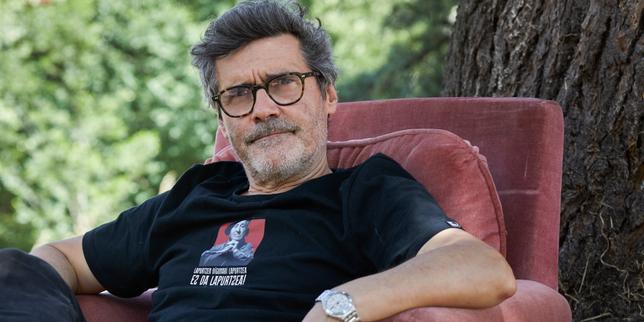
You probably know the name Chao because of the legendary punk-rock band Mano Negra or the solo global anthems of Manu Chao. But there is another brother whose entire life has been built on a different kind of decibel. Antoine Chao spent years playing trumpet in those chaotic, sweat-soaked alternative venues before transitioning into one of the most distinct voices in French independent radio.
He doesn't just make audio. He crafts resistance. His recent performance piece, Au départ, il y a Guernica, takes a deeply personal look at historical trauma, family exile, and the continuous threat of fascism.
It's a performance that mixes live sound design, raw noise music, and the literal cooking of a giant paella right in front of the audience. It sounds unconventional because it is. Chao understands that to keep history from becoming a dry, forgotten textbook chapter, you have to make people taste it, hear it, and feel it in their bones.
The Audio Barricade of Antoine Chao
To understand why this performance matters today, you have to look at where Antoine Chao comes from. He grew up in a household thick with political exile. His mother fled the horrors of the Spanish Civil War, and his father, the writer and journalist Ramón Chao, was actively involved in anti-Franco resistance as an exiled student. The Spanish Communist Party in exile used to hold meetings right in their living room.
When you grow up with history literally sitting on your sofa, you don't look at the world casually. Chao took that energy into the 1980s French alternative punk scene. It was an era defined by a fierce anti-fascist stance, heavy clashes with skinheads, and a collective refusal to let the far-right dictate cultural terms.
Later, Chao traded his trumpet for a microphone. Working on iconic, rebellious radio shows like Là-bas si j'y suis on France Inter, he learned to view the microphone as a weapon. He once described the radio studio as an "audio barricade" that needed to be held and defended at all costs.
With Au départ, il y a Guernica, he takes that barricade out of the radio studio and onto the theater stage. He isn't interested in passive listening. He wants a confrontation with memory.
A Five Year Old Girl and Sixty Tons of Bombs
The core of the performance relies on an intensely personal memory. On April 26, 1937, Antoine Chao’s mother, Felisa, was just a few weeks shy of her sixth birthday. She stood on the balcony of her family home in Artxanda, a hill overlooking the city of Bilbao.
From that vantage point, she watched German Nazi and Italian fascist warplanes streak across the sky. They were flying toward Guernica.
What happened next changed the nature of warfare forever. It was the first time in human history that military forces used carpet bombing specifically designed to terrorize and obliterate an entire civilian population. Over the course of less than three hours, forty-four planes from the Nazi Condor Legion and thirteen Italian fascist aircraft dropped sixty tons of high-explosive and incendiary bombs on a defenseless market town. As people fled the burning buildings, fighter pilots flew low to machine-gun them in the streets.
Chao opens the performance by grounding the audience in this terrifying reality. He uses a text by the celebrated Uruguayan writer Eduardo Galeano to frame the narrative. The performance tracks how his grandfather, Tomás Chao, joined the Republican army as a communications commander. Crucially, Tomás refused to carry a weapon. He chose to fight solely with wires, signals, and code.
Because of his role, fascist authorities condemned Tomás to death over the airwaves of Radio Sevilla. Yet he kept fighting until the final bitter days of the Republic, eventually escaping on the Lézardrieux—the very last ship to leave the port of Valencia on March 29, 1939.
Inside the Red and Black Paella
If you expect a standard documentary screening or a solemn historical lecture, you'll be completely caught off guard. Chao collaborates with artist Cécile Jarsaillon, who provides a harsh, jarring backdrop of noise music and live graphic design. Khia Hemici manages the heavy lifting of historical documentation and social science framing.
As the screech of noise music mimics the terrifying drone of bomber engines, Chao stands on stage doing something completely unexpected: he cooks a paella.
This isn't a gimmick. It is a calculated sensory tool. He calls it a "red and black" paella, utilizing the symbolic colors of the anarcho-syndicalist resistance movements that fought Franco's rise. The crackle of the rice frying in the pan blends directly with the static of archival radio broadcasts. The smell of the food fills the theater, creating a bizarre contrast between the warmth of a shared meal and the cold horror of the historical narrative.
By the time the performance ends, the paella is ready, and it is shared directly with the audience. Chao breaks down the invisible wall between the performer and the observer. You aren't just consuming a story about a war that happened nearly a century ago; you're sitting with your neighbors, eating the food of exile, and digesting the harsh truth that these political forces never truly went away.
The Radio as a Weapon of Transmission
We live in a moment where independent media faces massive financial and political consolidation. Chao’s work reminds us that independent audio work has always been a vital counterweight to authoritarian propaganda. His grandfather fought with radio transmissions; Chao fights with audio documentaries.
The performance illustrates a lesson that feels incredibly urgent in 2026: authoritarianism always seeks to control the airwaves first. When Franco’s forces condemned Tomás Chao over Radio Sevilla, they understood that controlling the narrative was just as important as dropping sixty tons of bombs.
Chao’s entire career has been a direct reaction to this. From his early days creating temporary, nomadic pirate radio stations across France to his long-standing work documenting modern social and environmental struggles, he treats audio as an active form of protest. He doesn't just report on the world; he uses sound to reshape how we understand it.
Beyond Mano Negra and Alternative Punk
Many critics try to frame Chao’s work as a nostalgic nod to his punk rock past. That misses the point entirely. The raw energy of Mano Negra wasn't just about loud guitars and high-energy live shows; it was an ideological stance against a sterile, corporate culture.
Au départ, il y a Guernica takes that exact same punk ethos and matures it. It trades the mosh pit for an intimate theater space, but the underlying anger and refusal to forget remain completely unchanged. It shows that staying radical doesn't mean doing the same thing forever. It means finding new, sharper ways to make people pay attention when the rest of the world prefers to look away.
What You Can Do Next
History isn't something that stays neatly tucked away in the past. The coalition of extreme-right forces that backed Franco in 1937 mirrors the rise of modern authoritarian movements globally. If you want to carry forward the kind of memory work Antoine Chao champions, here are the practical steps you can take today:
- Support Independent Sound Archives: Seek out and support independent audio collectives, community radio stations, and open-source audio archives that preserve oral histories from marginalized communities.
- Document Your Own Family History: Don't let your own family’s stories of migration, survival, or political struggle vanish. Use simple digital recorders to capture interviews with older relatives before those firsthand accounts are lost forever.
- Engage with Local Memory Initiatives: Look for local theater pieces, independent documentaries, and community exhibitions that challenge comfortable, sanitized versions of historical events.
Antoine Chao proves that remembering is an active, messy, and creative process. It requires us to show up, listen closely, and share the collective burden of keeping the truth alive.